When the Big Dipper sinks low behind the trees or disappears below the horizon, how do you find your way? Enter Cassiopeia.
This distinct “W-shaped” constellation is more than just a pretty pattern; it is the backup compass of the night sky. Sitting directly opposite the Big Dipper, the “Seated Queen” circles the North Star endlessly, making it the most reliable guide for autumn and winter stargazers.
In this guide, we won’t just show you how to spot the famous ‘W’—we’ll show you how to use it to navigate, identify its brightest stars, and locate the Andromeda Galaxy.
How to Locate the Queen: Using the Big Dipper and Polaris
If you are setting out to find the Cassiopeia W shape in the night, its circumpolar status makes the task straightforward. Its location is fixed by its perpetual relationship to the two most famous guides in the northern sky: the North Star (Polaris) and the Big Dipper (Ursa Major). Here is a straightforward circumpolar constellation guide to quickly finding the Queen:
-
- Find Polaris: Begin by locating the Ursa major big dipper cnstellation guide. The two outermost stars of the Dipper’s bowl act as “pointers” and lead the eye directly to Polaris, the North Star.
- Look Opposite: Cassiopeia is situated almost perfectly opposite the Big Dipper with respect to Polaris. Once you have located the North Star, simply look across it, roughly the same distance away as the Dipper, to find the Queen’s stars.
- Confirm the Celestial M or W: The final step is to confirm the pattern of the five bright stars, known affectionately as Cassiopeia’s Chair. Depending on the time of night or the season, you will clearly see the W or M shape.
The Secret Navigation Hack: Finding North with Cassiopeia
Most people learn to find the North Star (Polaris) using the Big Dipper. But in late autumn, the Dipper sits low on the horizon and is often blocked by buildings or mountains. This is when Cassiopeia becomes your primary navigation tool.
The “Open Top” Method: Notice that the “W” shape has an open side. Think of the constellation as a wide bowl. This open side always faces the North Star (Polaris).
If you draw an imaginary line bisecting the central angle of the “W” (shooting out from the central star, Gamma Cassiopeiae), it points almost directly to Polaris. This makes Cassiopeia an essential signpost for hikers and photographers in the Northern Hemisphere.
Geographic Visibility for Stargazers Worldwide
To truly appreciate Cassiopeia, knowing where to look based on your latitude is essential for observers in major markets like North America, Europe, Australia, and New Zealand:
- Northern Hemisphere (USA, Canada, UK): For anyone living north of 35°N latitude (including New York, London, and Toronto), Cassiopeia is a circumpolar constellation. This means it never sets and is visible every single night of the year, merely circling around the North Star.
- Optimal Viewing Time: While visible year-round, the Queen sits highest in the sky (the zenith) during November evenings around 9:00 p.m.
- Southern Hemisphere (Australia, NZ): This is a challenging target for the south. If you are south of 30°S latitude (including Sydney, Cape Town, and most of New Zealand), Cassiopeia never rises above the horizon. Observers in Northern Australia (like Darwin) may catch a brief glimpse of it low on the northern horizon from September to November.
When viewed in the autumn evening, it often presents the classic ‘W’ shape; later in the season or toward dawn, its appearance flips to a majestic ‘M’.
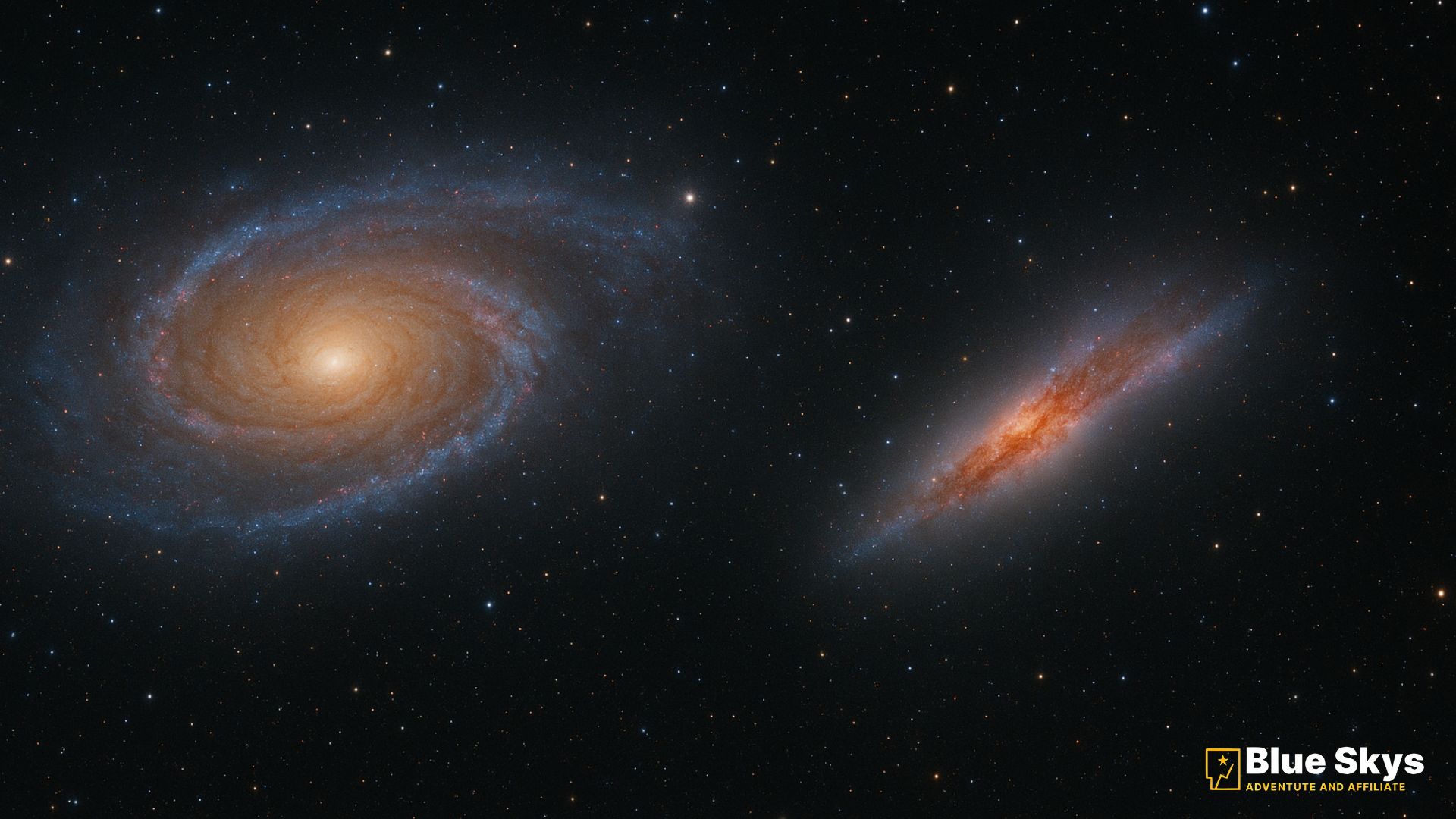
Tip: Cassiopeia’s proximity to the magnificent Andromeda Galaxy (M31) makes it an ideal landmark. Use the Queen’s stars as a springboard for locating that nearby galactic neighbour, particularly during the autumn and winter months.
Anatomy of the “W”: Portraits of the Five Brightest Stars
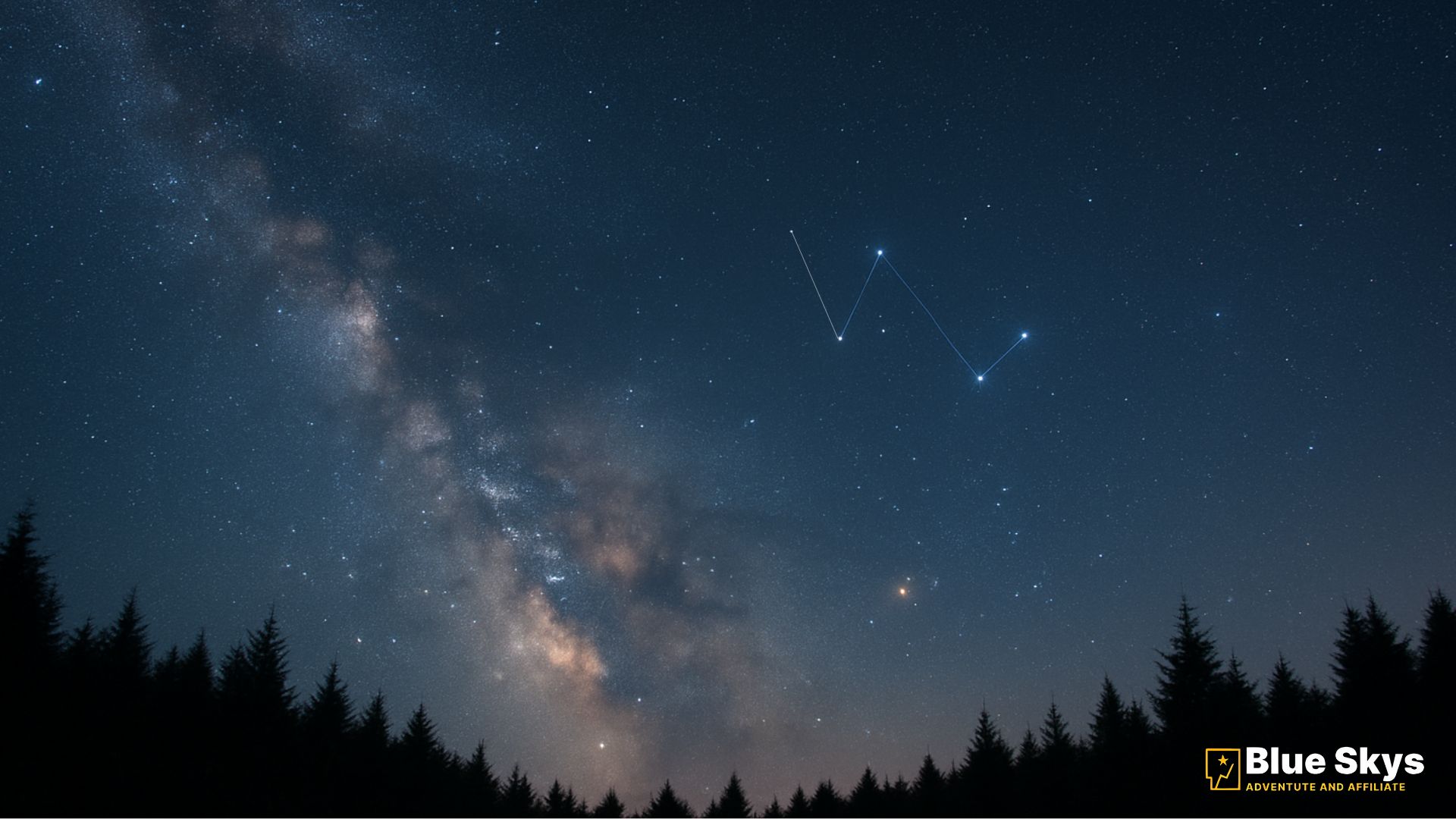
The distinct W/M shape is drawn by five principal stars, each with its own character and stellar dynamics. These components, which formally make up Cassiopeia’s Throne, are central to both visual recognition and modern astronomical study. The five brightest stars of Cassiopeia are Schedar ( Cas), Caph ( Cas), Gamma Cas ( Cas), Ruchbah ( Cas), and Segin ( Cas).
- Schedar (Alpha Cassiopeiae): Named “the breast,” Schedar is generally the brightest star. As an orange giant, it holds a steady glow, anchoring the far right of the W/M shape.
- Gamma Cassiopeiae: Positioned at the sharp center of the “W,” this star is far from placid. It is a highly luminous blue variable star. Whose brightness actively fluctuates, sometimes momentarily challenging Schedar for the title of the constellation’s brightest point.
- Ruchbah (Delta Cassiopeiae): Located in the left dip of the “W,” Ruchbah is scientifically fascinating because it is an Algol-type eclipsing binary star. Its light periodically dips as its companion star passes in front of it.
The following table serves as a comprehensive field guide to the stellar components of the W/M asterism, detailing the five brightest stars of Cassiopeia
| Common Name | Designation | Magnitude (m) | Description/Class | Position in W (Left to Right) |
| Segin | Epsilon Cassiopeiae (ϵ Cas) | 3.37 | Blue-White Giant (Hot & Young) | Far Left |
| Ruchbah | Delta Cassiopeiae (δ Cas) | 2.68 (varies) | Eclipsing Binary Star | Left Dip |
| Gamma Cas | Gamma Cassiopeiae (γ Cas) | 2.47 (varies) | Blue Variable Star | Center Dip |
| Schedar | Alpha Cassiopeiae (α Cas) | 2.24 | Orange Giant | Right Peak |
| Caph | Beta Cassiopeiae (β Cas) | 2.28 | Yellow-White Variable Star | Far Right |
Deep Sky Objects and Radio Source Authority
Because Cassiopeia slices through the stellar dust of the Milky Way, it offers rich hunting grounds for amateur astronomers exploring.
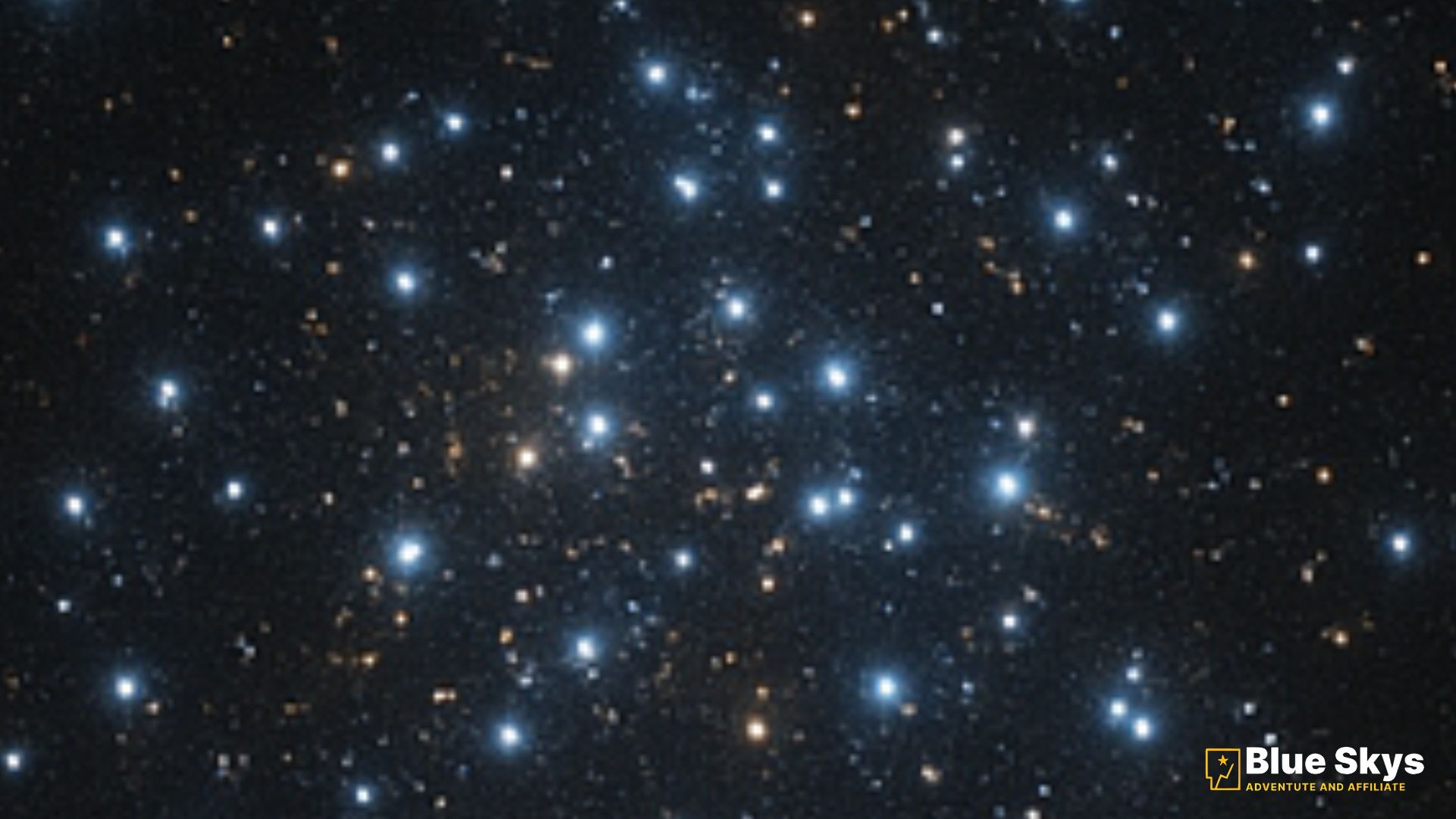
Notable Deep-Sky Targets:
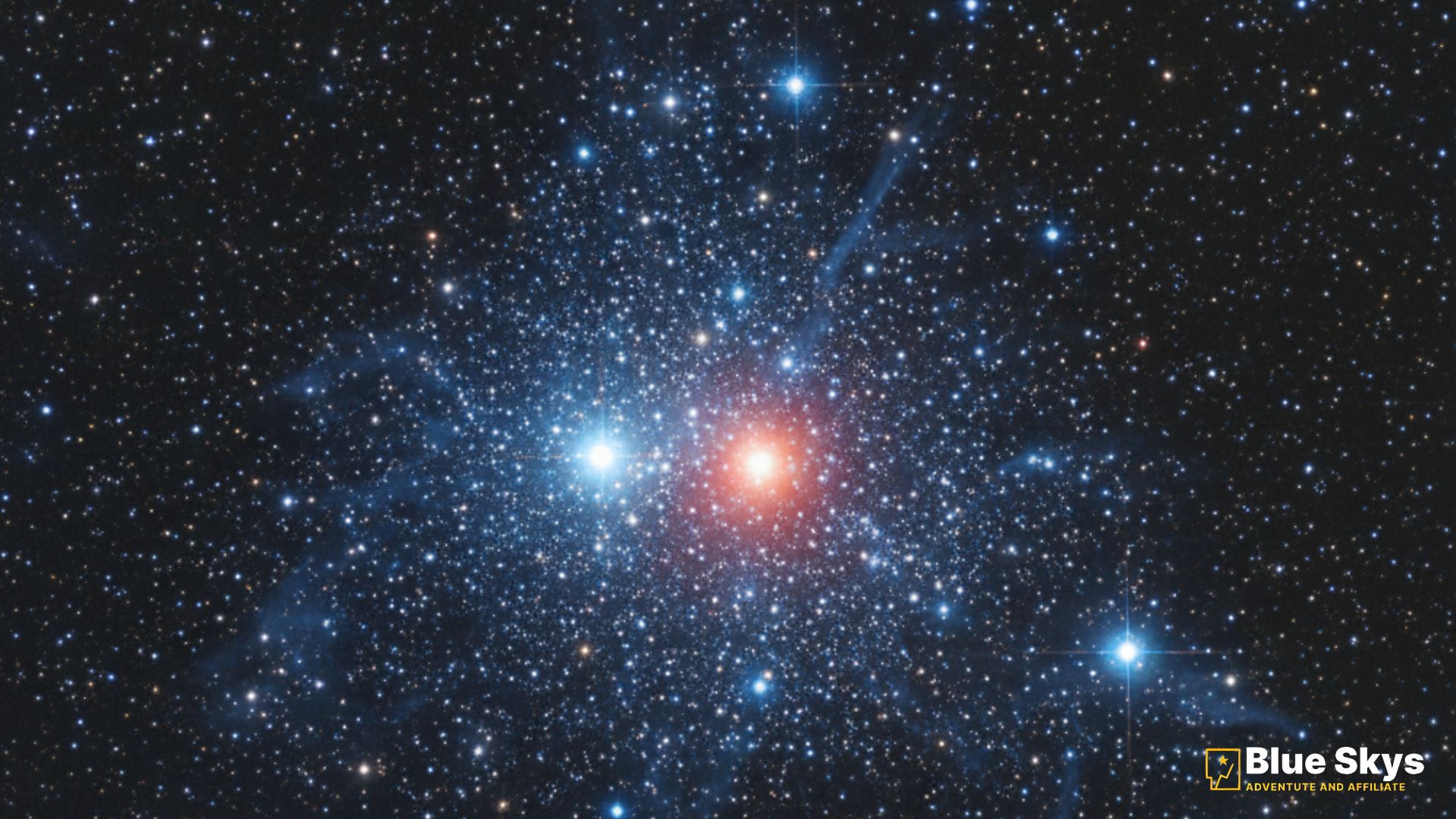
- Messier Clusters: For those asking what to see in Cassiopeia with binoculars, the constellation hosts two perfect targets: M52 and M103. M103 star cluster (NGC 7654) is a relatively young gathering of approximately 172 stars.
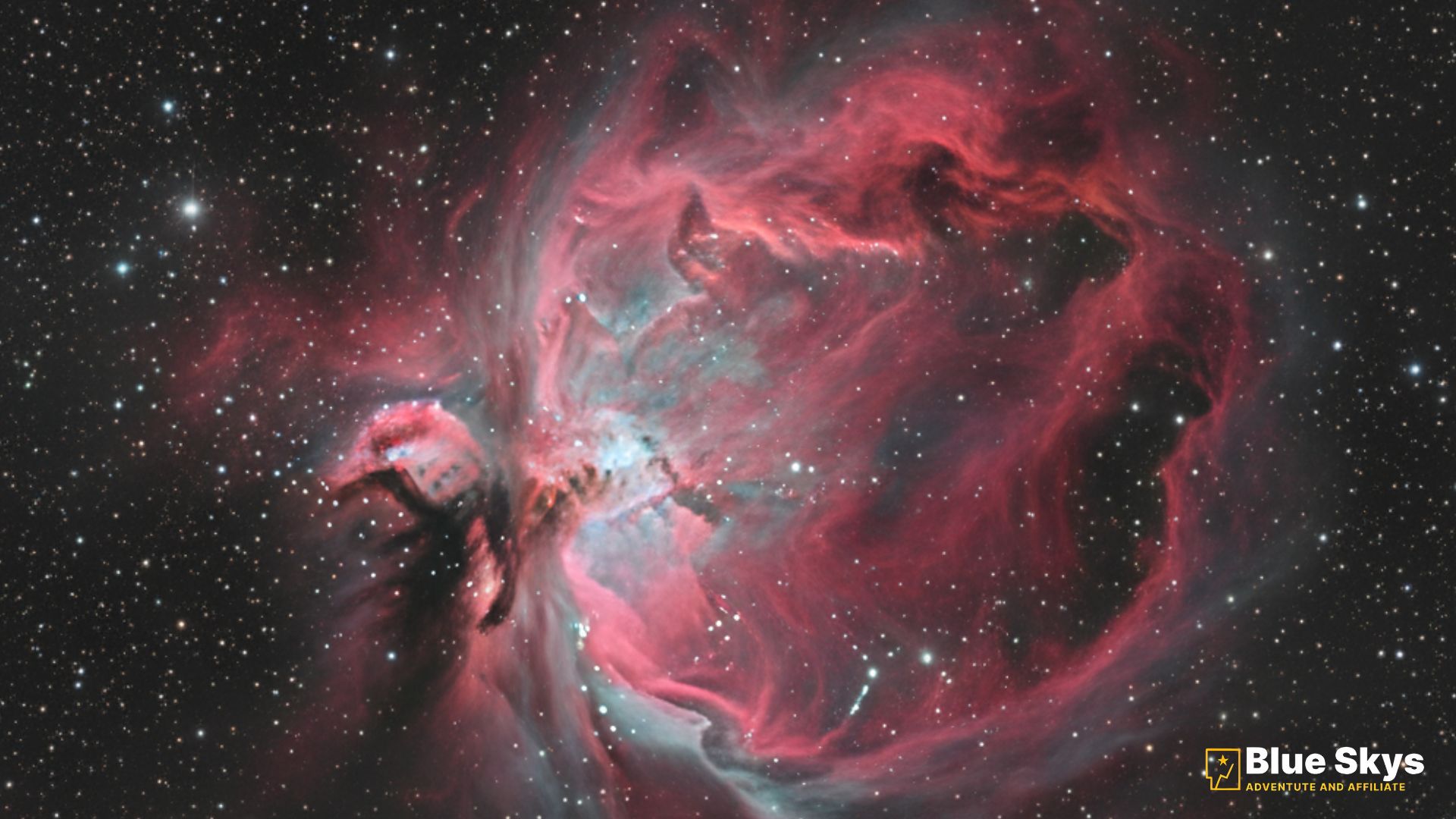
- The Pacman Nebula (NGC 281): A popular photographic target, this glowing nebula features a distinct dark lane, giving it its playful, informal name.
- Irregular Galaxy IC 10 Cassiopeia: This small, challenging galaxy is a member of our Local Group and a known satellite of the Andromeda Galaxy.
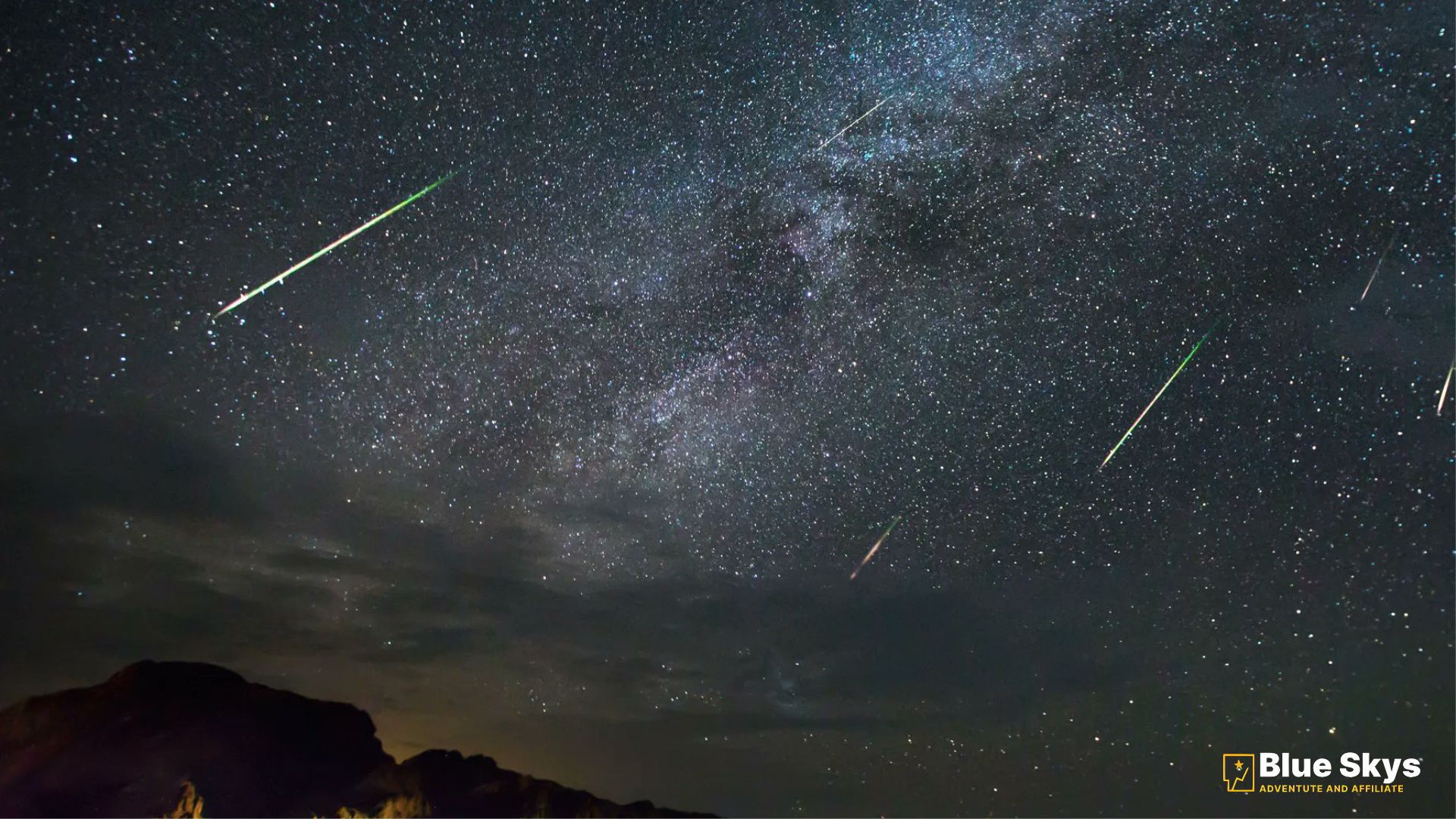
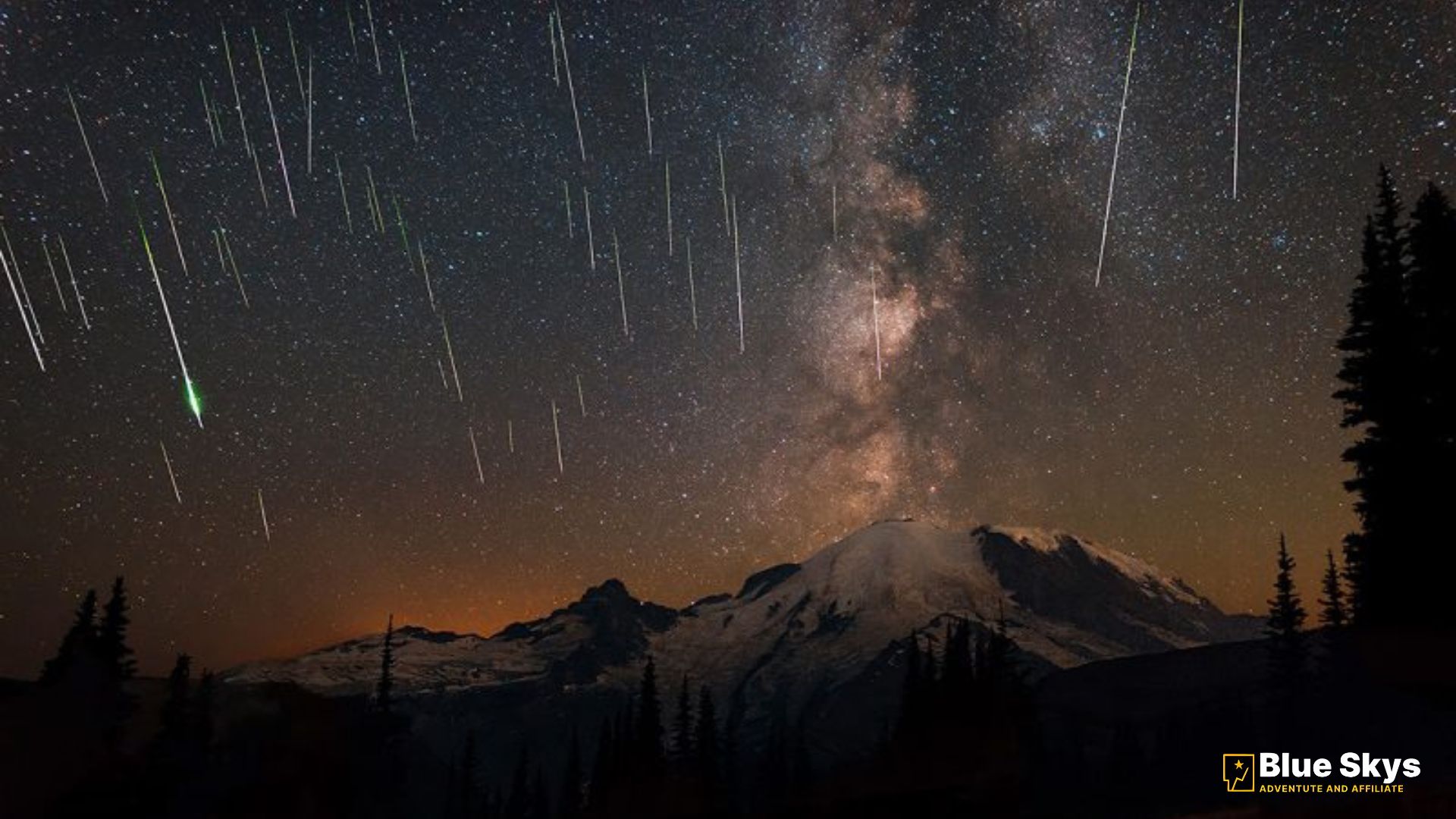
Note that while the Perseid meteor shower’s radiant lies in the nearby Perseus constellation, Cassiopeia is a perfect reference point for finding the shower’s origin and is often visible during the shower’s peak.
Cassiopeia A: Anatomy of the Brightest Extrasolar Radio Source
Perhaps the constellation’s greatest contribution to modern science is its status as the home of Cassiopeia A (Cas A). Cas A is the massive, glowing remnant of a star that violently exploded centuries ago. It is renowned as the strongest extrasolar radio source in the sky at frequencies above 1GHz, making it a cornerstone of radio astronomy. This cosmic explosion provides crucial data for astrophysics research. Scientists focusing on Cas A often utilize specialized technical phrases such as radio sources: 21 cm radiation and investigate the Interstellar matter being ejected from the remnant, placing Cassiopeia at the centre of our understanding of stellar death.
Historical and Mythological Significance
The Queen’s stars are interwoven with powerful human stories, connecting the modern night sky to ancient mythology and scientific breakthroughs.
Tycho Brahe and the Supernova of 1572
 Cassiopeia A is the cosmic ghost of an exploded star—its expanding shell and hidden neutron star offer a rare view of stellar rebirth
A profound celestial event cemented Cassiopeia’s place in astronomical history: the appearance of supernova SN 1572. This sudden, brilliant “new star” was meticulously recorded by the pioneering astronomer Tycho Brahe. Famously used Ptolemy’s magnitude system to compare the supernova’s brightness against surrounding field stars. That providing observational proof that the event occurred far beyond our solar system. Targeting Tycho Brahe supernova SN 1572 allows researchers to explore the foundational moments of observational astronomy.
The Myth of The Seated Queen

The constellation is named after Queen Cassiopeia of Aethiopia, wife of King Cepheus and mother of Andromeda. Her defining flaw was her overwhelming vanity and hubris (excessive pride). Her boast that she and her daughter were more beautiful than the Nereids, the sea nymphs, unleashed the wrath of the sea god Poseidon. As eternal punishment, the queen was placed in the sky. Chained to her throne where, when the constellation dips low. She appears to hang on for dear life. This vivid tale of the Cassiopeia mother of Andromeda punishment links Cassiopeia to the famous Perseus constellation family.
Cree Tradition: Elk Skin Constellation
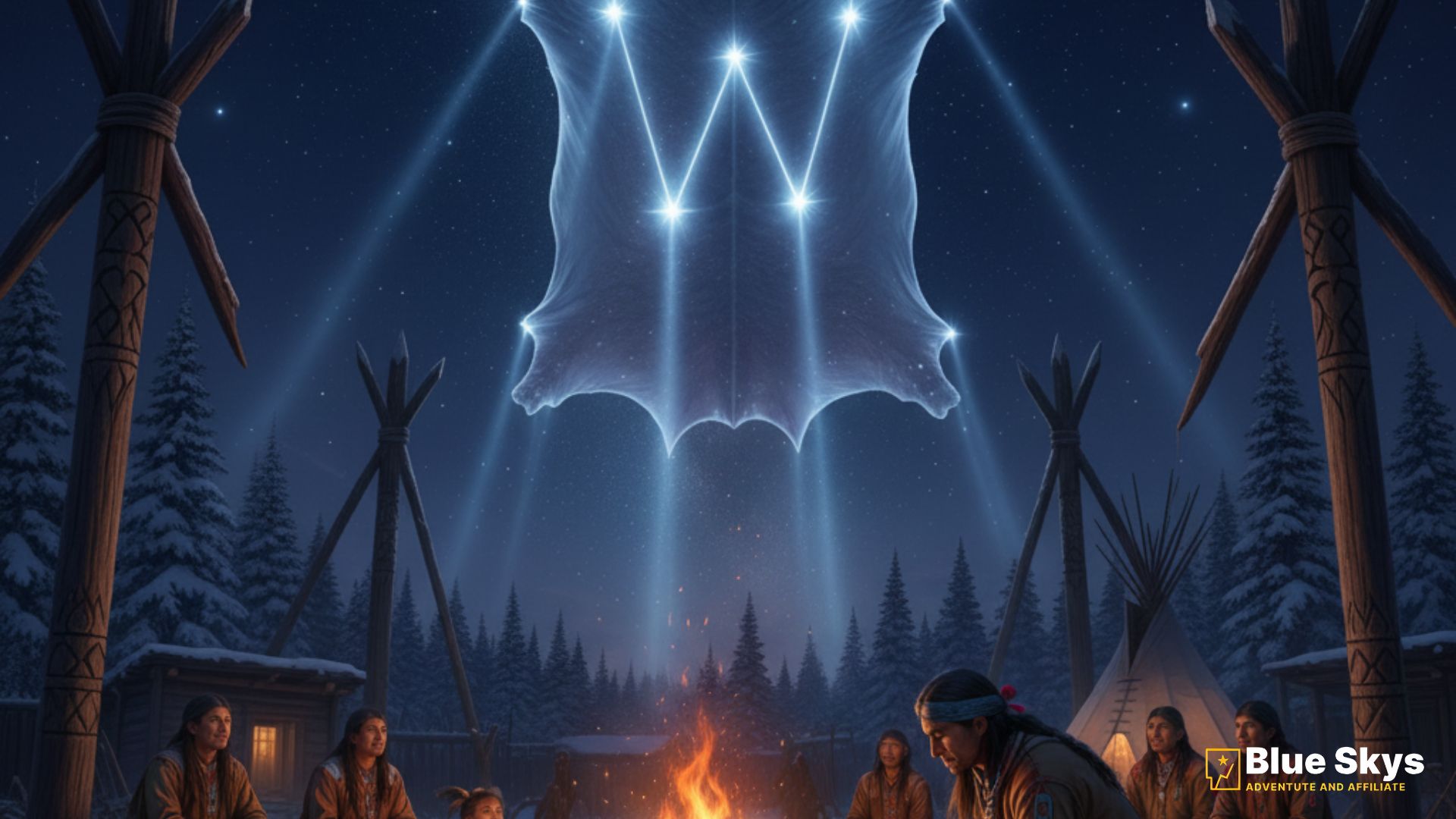
Offering a beautiful counterpoint to the Greek myth, Indigenous traditions present a different view. The Cree culture, the stars of the W/M shape are recognized as the Cree tradition elk skin constellation (Ponoka). This profound lore tells the story of a skilled hunter. Who stretched the hide of a great elk to honor the animal. With the stars marking the precise stake holes used to dry the skin. By recognizing the prominent constellation W or M in the north. And exploring its complex identity—from the mythological Lady of the Chair to the powerful astrophysics source Cas A—stargazers across the USA, Canada, UK, Australia, and New Zealand can find new dimensions in this familiar, easily located bright constellation that perpetually circles the northern sky.