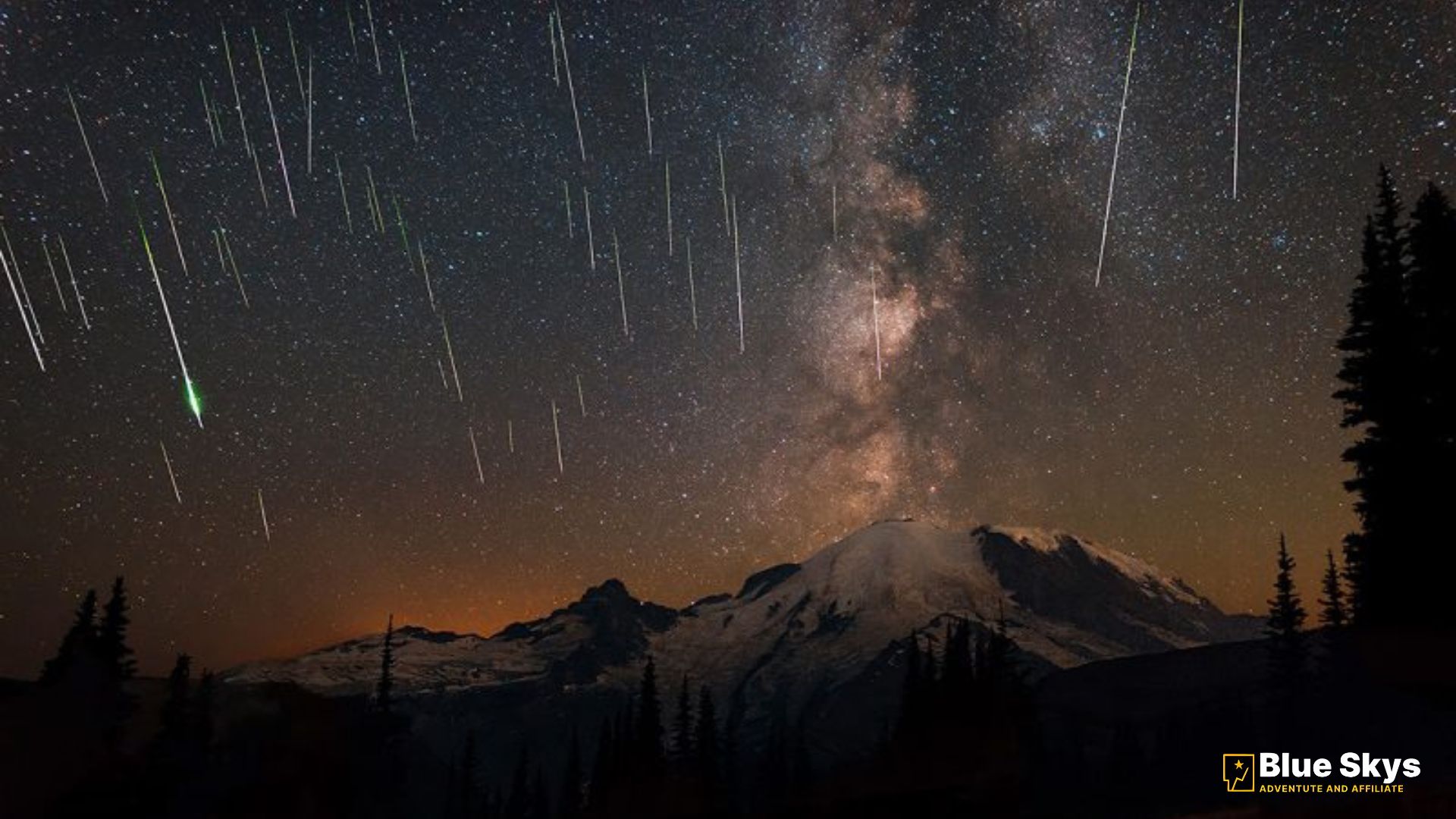
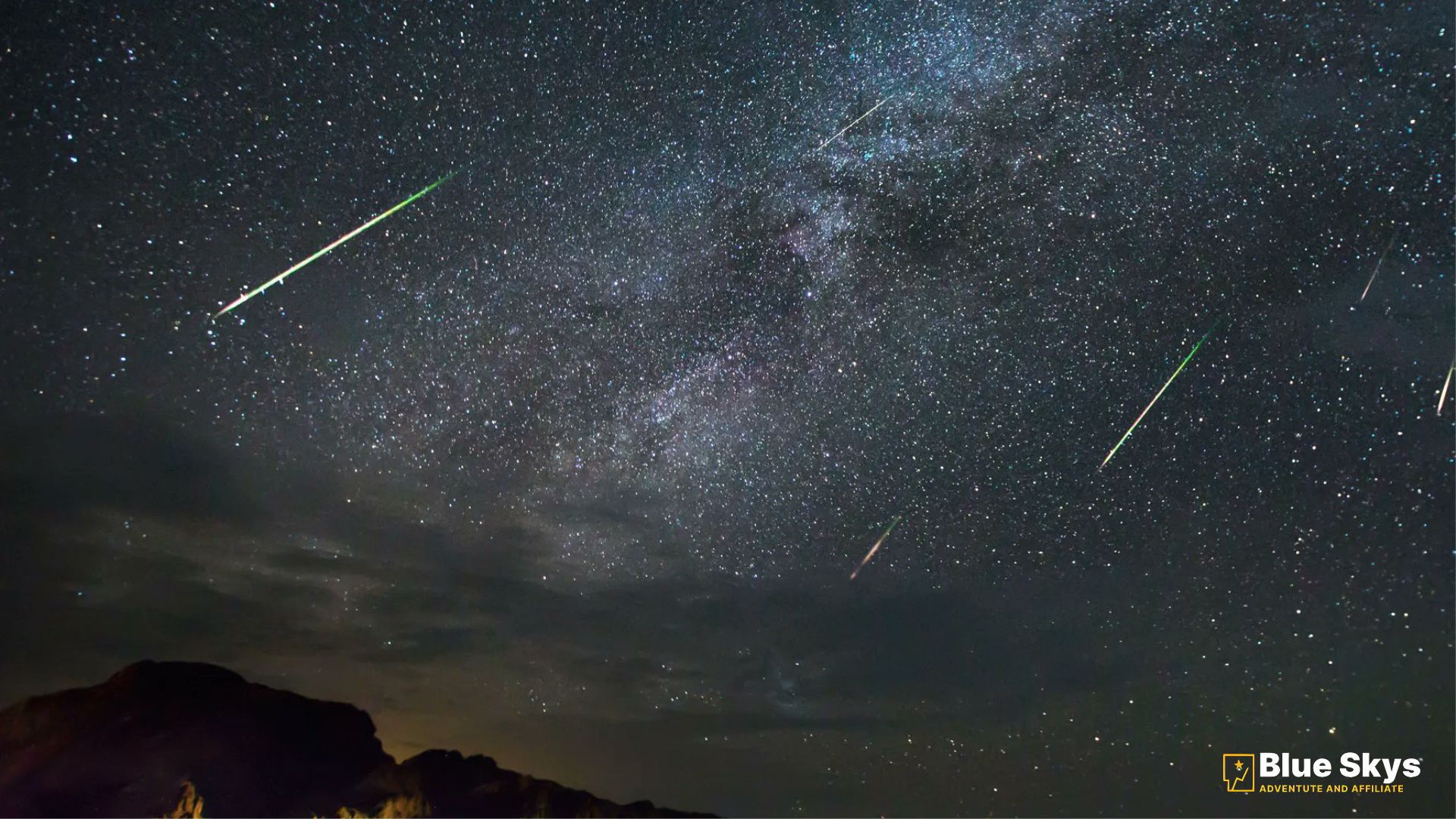
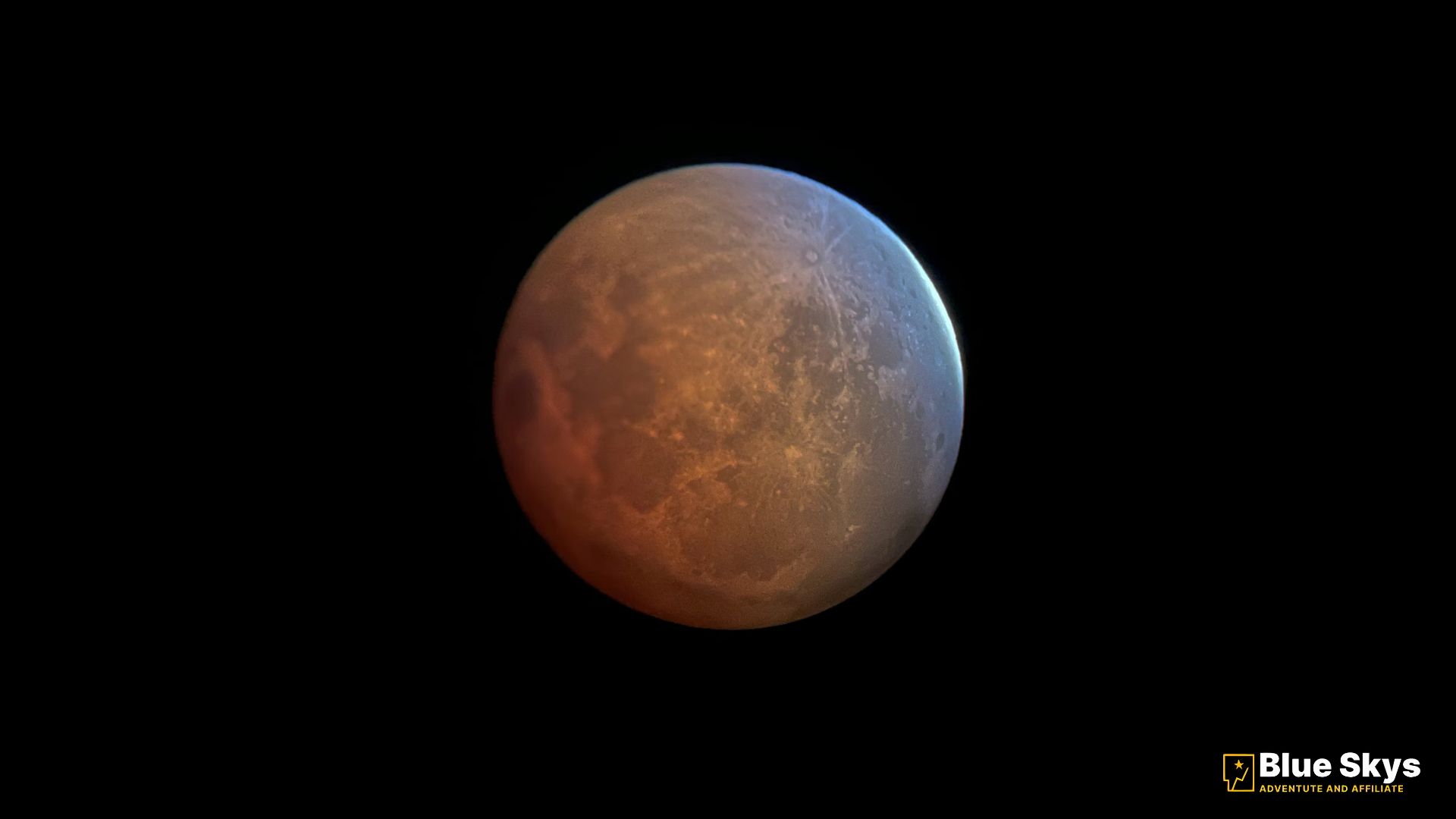
🚨 2026 Update: The Quadrantids peak on the night of January 3–4, 2026. This year coincides with a Full Moon, meaning you will only see the brightest “fireballs.” Timing is critical: Aim for the pre-dawn hours.
Quadrantid Meteor Shower Guide: How to Watch in 2026
Most stargazers hibernate in January. But for those brave enough to face the cold, the Quadrantid Meteor Shower offers a unique challenge.
On the night of January 3, 2026, Earth will pass through the debris trail of asteroid 2003 EH1. While the Quadrantids are famous for producing up to 110 meteors per hour, 2026 will be different.
The peak coincides with a bright Full Wolf Moon.
Does this mean you should stay inside? No. The Quadrantids are famous for producing bright fireballs with glowing trains that can cut through the moonlight. In this guide, we will show you how to block the moon, find the radiant using the Big Dipper, and catch the best of the shower.
🚀 Quick Facts: Quadrantids 2026
Peak Night: Late night Jan 3 into early morning Jan 4.
Best Window: 3:00 AM to Dawn (Your Local Time).
Moon Phase:Full Moon. (Visibility will be lower than usual).
Radiant Point: Between Boötes and Draco (near the Big Dipper’s handle).
The Goal: Spotting bright Fireballs.
Quadrantids Peak Time Tonight (Jan 3–4)
How to find the radiant: Follow the handle of the Big Dipper down towards Arcturus. The shower originates in the “void” between the handle and Draco.
The Quadrantids have a notoriously short peak window—only about 6 hours. Outside of this window, activity drops to near zero.
Because of the Full Moon, faint meteors will be invisible. You are hunting for the big ones. Here is your best viewing schedule:
Region / Time Zone
Best Viewing Window
2026 Forecast
🇺🇸 USA (EST)
3:00 AM – 6:00 AM (Jan 4)
🌕 Moon Interference
🇺🇸 USA (PST)
2:00 AM – 5:30 AM (Jan 4)
🌕 Moon Interference
🇬🇧 UK (GMT)
1:00 AM – 6:30 AM (Jan 4)
🌕 Moon Interference
🇪🇺 Europe (CET)
2:00 AM – 7:00 AM (Jan 4)
🌕 Moon Interference
How to Block the Moon & Find the Radiant
The radiant point is in the constellation Boötes (the Herdsman). To find it, look North for the Big Dipper. Follow the curve of the handle down towards the bright star Arcturus. The radiant is in the “void” between the Dipper’s handle and Draco.
The “Moon Block” Strategy: Since the Full Moon will be bright, do not face the moon.
Position yourself so a building, tree, or hill blocks the Moon from your direct line of sight.
Face North (toward the Big Dipper), keeping the Moon behind you.
Look straight up at the darkest patch of sky you can find.
Quadrantids Survival Checklist (Cold Weather)
The 2026 Strategy: Since the Full Moon is bright, position yourself so a building or tree blocks it from your direct view while you face North.
Since this is a January shower, the cold is your biggest enemy. Hypothermia can set in quickly if you are standing still at 3 AM.
❄️ The “Stay Warm” Checklist
✅ The Double-Sock Rule: Wear a thin synthetic liner sock under a thick wool sock. Tight boots cut off circulation, so keep them loose!
✅ Battery Warmers: Lithium-ion batteries die fast in the cold. Tape a hand warmer to the back of your phone or camera battery.
✅ Isolation Layer: Don’t sit directly on the ground. Put a foam pad or wool blanket under you.
✅ Lens Defogger: Wrap a hand warmer around your camera lens with a rubber band to stop frost from forming on the glass.
📸 Photographer’s Recipe: Shooting in Moonlight
The Full Moon actually lights up the foreground, which can create cool photos if you catch a bright meteor.
Lens: Wide Angle (14mm – 24mm)
Aperture: f/4 or f/5.6 (Stop down slightly because of the bright moon)
ISO: 800 or 1600 (Lower than usual to avoid overexposure)
Shutter Speed: 10 to 15 seconds
Goal: Capture a “Fireball” streak against the blue moonlit sky.
Final Verdict: Is it Worth the Cold?
If you are looking for 100 meteors an hour, you might be disappointed this year. But if you are a dedicated stargazer looking to catch one or two spectacular fireballs that outshine the moonlight, the Quadrantids are still a thrill. Bundle up, block the moon, and good luck!
💡 Quick Answer: The Big Dipper is not a constellation. It is an “asterism” (a recognizable star pattern) that forms the tail and hips of the larger constellation Ursa Major (The Great Bear).
Ursa Major (Big Dipper): The Indispensable Northern Icon
Most people can spot the Big Dipper. It is the most famous pattern in the northern sky. But here is the secret most beginners miss: The Big Dipper is just a small part of the story.
It is actually the tail of a much larger, majestic beast: Ursa Major, the Great Bear. In this guide, we will show you how to find the full Bear, how to use its famous “Pointer Stars” to navigate, and why this single constellation is the key to unlocking the entire night sky.
👀 Can I see the Big Dipper tonight?
🇺🇸 USA / 🇬🇧 UK / 🇨🇦 Canada:YES. Visible all night. Look North. It will be low on the horizon in autumn evenings and high overhead in spring.
🇦🇺 Australia / 🇳🇿 NZ:NO. The Big Dipper is not visible from most of the Southern Hemisphere (south of 25°S). Look for the Southern Cross instead!
The Ultimate Sky Hack: Finding North with the Big Dipper
Before GPS, sailors used Ursa Major to navigate the open oceans. You can use the same trick tonight to find your way in the dark.
The “Pointer Stars” Method:
Find the Bowl: Look for the four bright stars that form the “cup” of the Dipper.
Spot the Edge: Focus on the two outer stars of the bowl, named Dubhe and Merak.
Draw a Line: Imagine a straight line shooting out from Merak, through Dubhe, and into the sky.
Find Polaris: Extend that line about 5 times the distance between the two stars. The first bright star you hit is Polaris (The North Star).
Pro Tip: Once you find Polaris, you are facing True North. Polaris also marks the handle of the “Little Dipper” (Ursa Minor).
The “Pointer Stars” (Dubhe and Merak) act as a cosmic compass, leading you directly to the North Star.
Constellation vs. Asterism: Defining the Great Bear
To fully understand this celestial giant, we must distinguish between the “Bear” and the “Dipper.”
The term Ursa Major, translating from Latin as “The Greater Bear”, refers to one of the 88 official constellations recognized globally by the International Astronomical Union (IAU). It is the third-largest constellation in the sky and encompasses a vast region of stars beyond the famous seven.
In contrast, the Big Dipper is an asterism—a prominent nickname for the pattern that looks like a ladle, scoop, or wagon. By recognizing that the Dipper is merely the tail and hindquarters of the much larger Great Bear, observers gain a deeper appreciation for its true scale.
Following the Arc to Other Stars
The Dipper’s structure acts as a reference point for locating other constellations, not just the North Star. Astronomers use the famous mnemonic: “Arc to Arcturus.”
The arc is formed by the three stars of the Dipper’s handle (Alioth, Mizar, and Alkaid). Following this graceful, sweeping curve away from the bowl naturally leads the eye to Arcturus, a bright red-orange giant that is the primary star of the constellation Boötes.
Mythology and Cultural Significance
The rich history surrounding Ursa Major offers a compelling look at how various human cultures have interpreted the cosmos.
Greek mythology explains the Bear’s unusually long tail—stretched when Zeus flung Callisto into the heavens.
The Classical Tale of Callisto and Zeus
The most pervasive Western narrative comes from Greek mythology. The story explains the constellation’s peculiar, long tail—unnatural for a biological bear. The myth tells of the nymph Callisto, who was transformed into a bear by Zeus to protect her from the jealous rage of Hera. Zeus then seized the bear by its short stubby tail and violently flung her high into the heavens, permanently stretching the tail into the long form seen in the stars today.
Legends of the New World
In the United States, the Big Dipper holds profound historical significance. During the era of slavery, the asterism was often referred to as “The Drinking Gourd.” Enslaved people relied on the Dipper’s Pointers to locate Polaris, which reliably directed them north toward freedom on the Underground Railroad.
Deep-Sky Wonders: A Window to the Universe
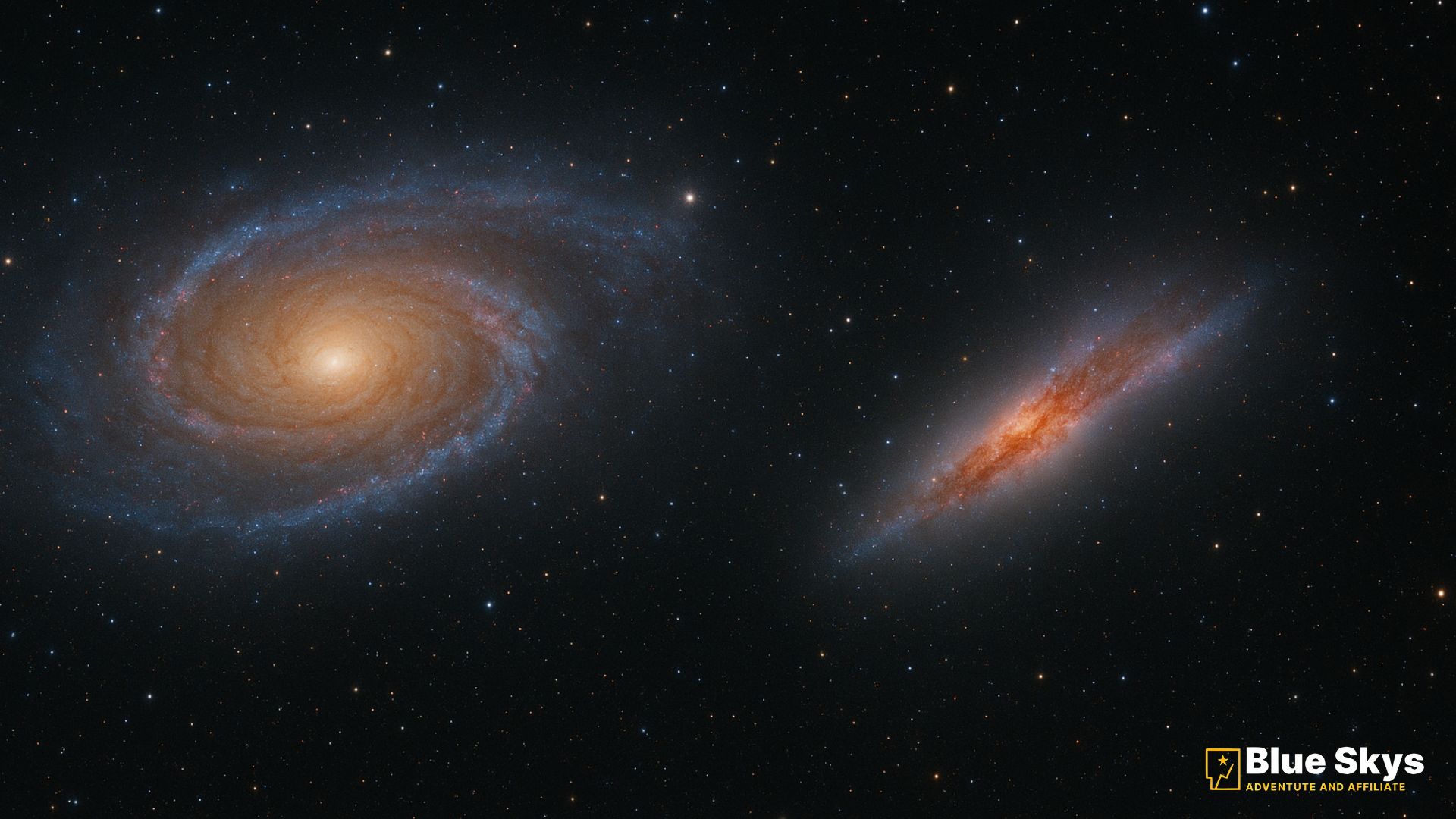
Ursa Major hosts the spectacular galactic pair: Bode’s Galaxy (M81) and the Starburst Cigar Galaxy (M82).
Ursa Major looks away from the dense dust of the Milky Way, giving us a clear window into deep space. It contains some of the brightest galaxies visible from Earth.
Key Galactic Targets
Bode’s Galaxy (M81): A magnificent, bright spiral galaxy.
The Cigar Galaxy (M82): A “starburst” galaxy seen edge-on, physically interacting with M81.
The Pinwheel Galaxy (M101): A large, beautiful face-on spiral galaxy located 21 million light-years away.
You don’t need a Hubble Telescope to photograph these galaxies. Here is the starter recipe for a standard DSLR + Tripod:
Lens: 200mm – 300mm telephoto lens
Aperture: f/4 or f/5.6 (wide open)
ISO: 1600 or 3200
Shutter Speed: 1.5 to 2 seconds (without a tracker)
The Secret: Take at least 100 photos (“lights”) and stack them using free software like DeepSkyStacker to reveal the spiral arms.
The Dipper’s Dynamic Future
The stars are not stationary. They are moving independently through space (Proper Motion). Scientifically, it is predicted that in approximately 100,000 years, the seven stars will have moved far enough apart that the Big Dipper will lose its ladle shape, appearing more like a “shoe.” This confirms that constellations are temporary snapshots in cosmic time.
Best stargazing apps for beginners in 2025 are changing the way we connect with the night sky. Whether you’re using an iPhone or Android device, these Top 10 Best Stargazing Apps for Beginners in 2025 help you explore stars, planets, and constellations easily—even without a telescope.
App Name
Best For
Price
1. Stellarium Mobile
Realism & Accuracy
Free
2. Star Walk 2
Beautiful Graphics
Freemium
3. SkyView Lite
Augmented Reality (AR)
Free
4. PhotoPills
Photography Planning
$10.99
Quick Comparison: Top Stargazing Tools for 2025
Key Features Beginners Should Look For
Augmented Reality (AR) sky overlays
Offline mode for remote stargazing
Interactive maps with tap-to-learn capability
Personalized notifications for space events
Educational content for learning constellations and astronomy
Cross-platform support (iOS, Android)
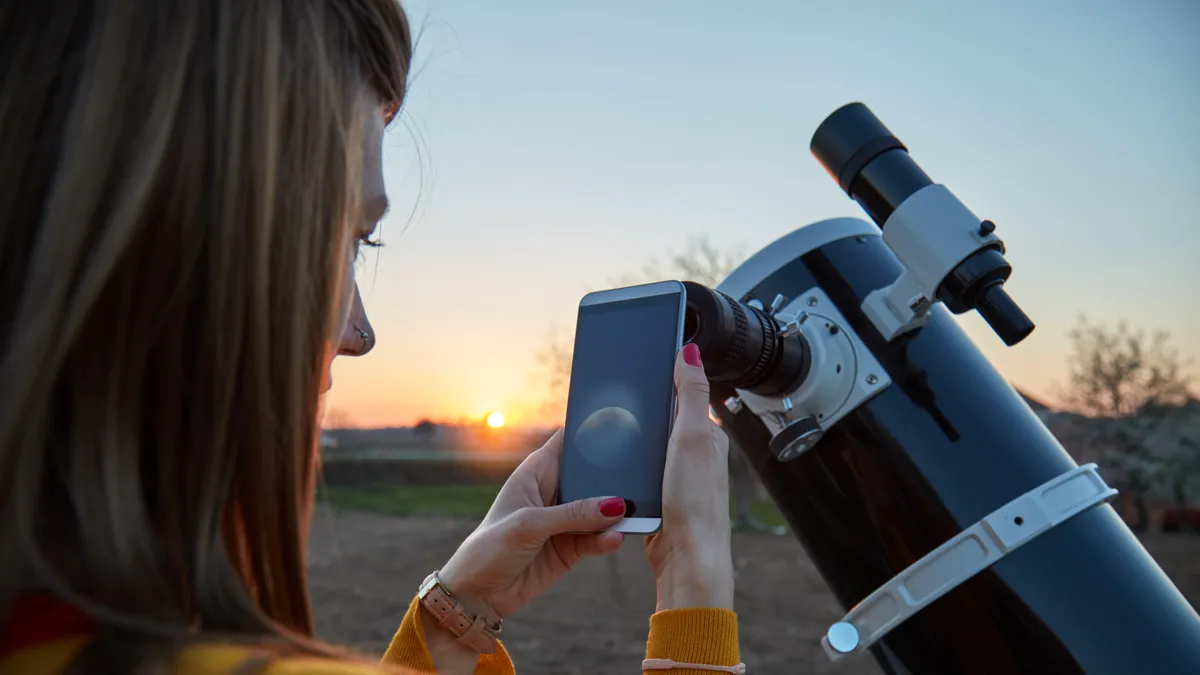
Using a stargazing app to explore constellations under a clear night sky.
Unlike older versions, the 2025 updates for Stellarium and Star Walk 2 now feature dedicated “Event Trackers.”
Why this matters right now: If you are trying to watch the Geminid Meteor Shower (Peaking Dec 13-14), you can use these apps to find the “Radiant Point” in the constellation Gemini. Simply type “Gemini” into the search bar, hold your phone up, and the app will guide you to the exact spot where the meteors originate.
1. SkySafari 7 Pro
SkySafari 7 Pro combines a beginner-friendly interface with advanced features like telescope syncing and AI learning. It lets users simulate celestial events from any location or time, and its database covers millions of stars, galaxies, and nebulae.
New for 2025: AI-guided lessons, wearable alerts, and live telescope control
Great for: Learners who want depth and telescope users
2. Star Walk 2
With its breathtaking AR visuals, Star Walk 2 turns your phone into a moving sky theatre. It overlays constellations and planets in real-time, complete with mythology and astronomy facts.
Features: Time Machine for past/future sky views, live solar weather updates
Perfect for: Families, educators, and casual night sky enthusiasts
3. Stellarium Mobile Plus
Stellarium brings the precision of a planetarium to your pocket. It’s loaded with sky simulation tools and a vast object catalog.
Best for: Beginners who want a realistic night sky and immersive learning
New for 2025: Interactive sky tours, quizzes, and telescope field simulation
4. SkyView Lite
Ideal for beginners, SkyView Lite offers simple sky tracking with no ads or fluff. It shows satellites, stars, and constellations with a clean UI and works offline.
Standout: Lightweight, accurate, and free
New in 2025: Tap-to-learn quick facts + ISS tracking notifications
5. Night Sky
Exclusive to Apple users, Night Sky blends storytelling with augmented sky exploration. It syncs across iPhone, iPad, and even HomePod.
New for 2025: Space Tours and AI-powered daily briefings
Best for: Apple lovers looking for beauty and function
6. Sky Map (Google Sky Map)
Sky Map is open-source, ultra-light, and beloved by Android users. It labels stars and planets instantly and works great offline.
Perfect for: Anyone wanting a minimalist, zero-cost app
Latest updates: Time Travel mode and manual location calibration
7. Heavens Above
Heavens Above is a specialist app for satellite tracking. Want to see the ISS or Starlink? This is the tool.
New in 2025: 3D satellite path simulator, live rocket launch alerts
Best for: Astrophotographers and real-time space watchers
8. Star Chart
Star Chart makes stargazing fun for kids and classrooms. With voice commands and gamified sky quests, it’s built for beginners who love to learn while exploring.
Perfect for: Schools, families, and first-time users
9. Solar Walk 2
Rather than just identify stars, Solar Walk 2 takes you on a 3D journey through the solar system. It’s interactive, educational, and gorgeous.
Use case: Visual learners or astronomy students
Bonus in 2025: VR space station rides, asteroid belt exploration
10. Sky Tonight by Vito Technology
A rising star in 2025, Sky Tonight customizes your stargazing night with tailored viewing plans, object highlights, and event alerts.
Coolest feature: AI-powered smart calendar + AR navigation
Great for: Anyone who wants a daily guided night sky experience
Bonus Tools and Accessories for Stargazing with Apps
Red flashlight: Maintains night vision
Tripod: Keeps phone steady for photography
Telescope phone mount: Aligns your camera with telescope eyepieces
Power bank: Keeps devices charged during long sessions
Blanket or chair: Comfort during long skywatching hours
Astrophotography Companion Apps
App Name
Use Case
PhotoPills
Milky Way planning & moon phases
Light Pollution Map
Find darkest skies near you
Sky Guide
iOS astrophotography + weather sync
Conclusion: Stargazing Is Just a Tap Away
In 2025, stargazing has never been easier—or more exciting. According to NASA’s Skywatching guide, 2025 will be an incredible year for planetary alignments. With just a phone and the right app, you can explore galaxies, track satellites, or catch a meteor shower. These Top 10 Best Stargazing Apps for Beginners in 2025 are more than utilities—they’re gateways to curiosity, wonder, and the cosmos.
Whether you’re a backyard explorer or a budding astrophotographer, these apps turn every night into a cosmic classroom. So grab your phone, download one of these top picks, and look up—the universe is just a tap away.
FAQs
Do I need internet access to use stargazing apps?
Not all the time. Apps like SkyMap, SkyView Lite, and Stellarium offer offline use. Always preload data before heading to remote areas.
Which app is best for real-time tracking of planets and satellites?
SkySafari and Sky Tonight for planets. Heavens Above for ISS, Starlink, and satellites.
Are free stargazing apps accurate enough?
Yes! Apps like Sky Map and SkyView Lite are very accurate for basic star and planet identification.
What’s the best stargazing app for iOS vs Android?
iOS: Night Sky, Sky Tonight
Android: Sky Map, Stellarium, SkySafari
Can stargazing apps help with telescope alignment?
Yes. Apps like SkySafari 7 and Stellarium Mobile can sync with smart telescopes and guide manual alignment.
🌍 Which App is Best for My Location?
One of the most common questions we get is about accuracy in different hemispheres. Here is the quick verdict:
🇺🇸 USA & 🇨🇦 Canada (Northern Hemisphere):SkyView Lite is excellent here. Its compass calibration works flawlessly in North America, making it easy to spot Polaris (The North Star).
🇦🇺 Australia & 🇳🇿 New Zealand (Southern Hemisphere): We recommend Stellarium Mobile. It automatically flips the star chart based on your GPS, helping you easily identify the Southern Cross (Crux) and Alpha Centauri.
🇬🇧 UK & Europe:Star Walk 2 is a favorite for its “Cloud/Weather” integration, which is essential for the often cloudy British skies.
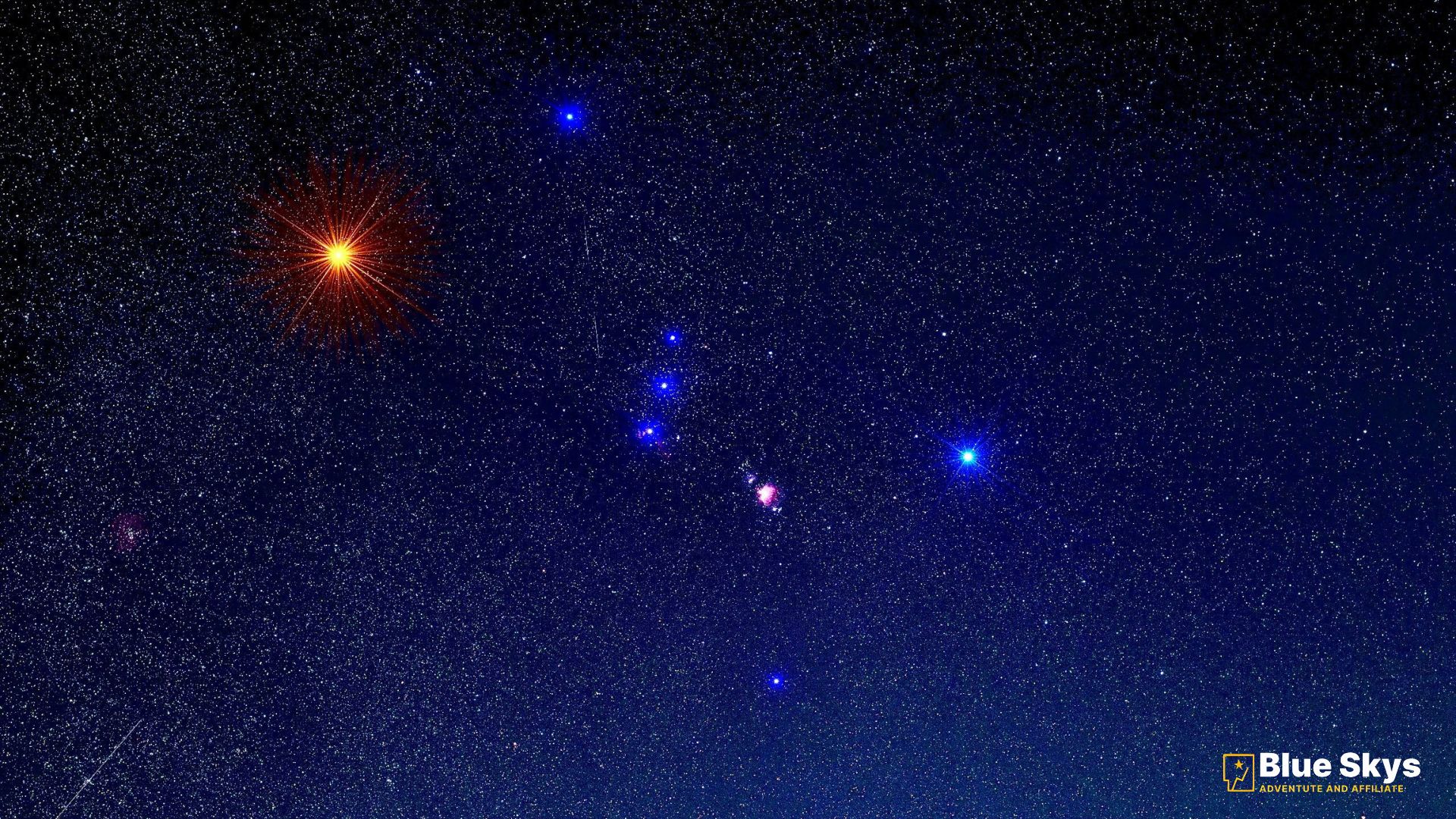
In the Northern Hemisphere (Winter), face South after sunset. Look for three bright stars in a short, straight row—this is Orion’s Belt. Use the Belt to find the glowing Orion Nebula (M42) hanging just below it.
Welcome to the night sky’s most spectacular show! Here’s what you need to know about finding the Orion the Hunter constellation for beginners. Why Orion is called ‘The Hunter’? This massive figure is one of the easiest landmarks to spot and the cornerstone of the Winter Constellations.
When to See Orion (Regional Visibility)
Orion is visible globally, but your view depends on where you stand on Earth. Here is your visibility forecast for Winter 2025/2026:
Region
Look Direction
Best Time (Jan-Feb)
🇺🇸 USA / 🇨🇦 Canada
Face South (High in sky)
8:00 PM – Midnight
🇬🇧 UK / 🇪🇺 Europe
Face South (Mid-sky)
7:00 PM – 11:00 PM
🇦🇺 Australia / 🇳🇿 NZ
Face North (Upside Down!)
9:00 PM – Midnight
Use Orion’s Belt to find the Orion Nebula (M42) and star‑hop to Sirius and Aldebaran.
What is the Orion the Hunter Constellation?
The Orion the Hunter Constellation (Orion) is one of the brightest and most recognizable patterns in the night sky. It symbolizes a mighty hunter from Greek mythology, often depicted with a shield and club. This celestial figure spans the celestial equator, making it uniquely visible from nearly all parts of the Earth, lying between latitudes +85° and −75°. While known for its two brightest stars—the red supergiant Betelgeuse (α Orionis) and the blue supergiant Rigel (β Orionis)—the figure includes four other critical markers: Bellatrix (the left shoulder), Saiph (the right knee), and the three bright stars that form Orion’s Belt. Older astronomical texts frequently refer to the most famous deep-sky object in this constellation as the Great Nebula in Orion.
How to Find Orion the Hunter: A Simple 3-Step Guide
Orion dominates the night sky during the cooler months, making it one of the easiest constellations for a beginner to spot. Once you’ve learned major navigation points like the Ursa Major (Big Dipper) and Polaris, Orion is the natural next step. We’ll show you how to find Orion’s Belt easily.
Know the Season: The constellation is best viewed in the evening sky during the Northern Hemisphere winter and the Southern Hemisphere summer, generally from November through March. In January, Orion’s Belt is typically highest around 9:00 PM.
Locate the Belt: Scan the southern horizon (in the Northern Hemisphere) for three bright stars aligned in a distinct, short, nearly straight row. This highly recognizable pattern forms the Hunter’s Belt.
Identify the Shoulders and Feet: Once the Belt is found, the rest of the figure becomes clear. The two bright stars north of the belt are the shoulders (including the distinctive reddish Betelgeuse), and the two bright stars to the south form the feet, featuring the brilliant, blue-white Rigel.
Star-Hopping from Orion’s Belt
Orion’s Belt acts as an essential celestial pointer for navigating the sky:
To Sirius: Draw an imaginary line extending down and to the left through the three belt stars. This line points directly to Sirius, the brightest star in the entire night sky, located in the Canis Major constellation.
To Aldebaran: Trace the same imaginary line up and to the right. This points toward the reddish star Aldebaran, the eye of Taurus, the Bull.
Wonders Within Orion: The Great Nebula and Brightest Stars
📸 Photographer’s Recipe: Capturing the Orion Nebula (M42)
Target: The middle “star” of Orion’s Sword Difficulty: Beginner
M42 is so bright that you can capture it with a standard DSLR and a tripod—no telescope needed.
Lens: 50mm to 135mm (Zoom in on the Sword)
Aperture: f/2.8 or f/4 (Wide open)
ISO: 1600 or 3200
Shutter Speed: 1.5 to 2.5 seconds (Any longer and stars will trail)
The Secret: Use a 2-second self-timer so you don’t shake the camera when pressing the button. You will see a distinct pink/purple glow in the photo!
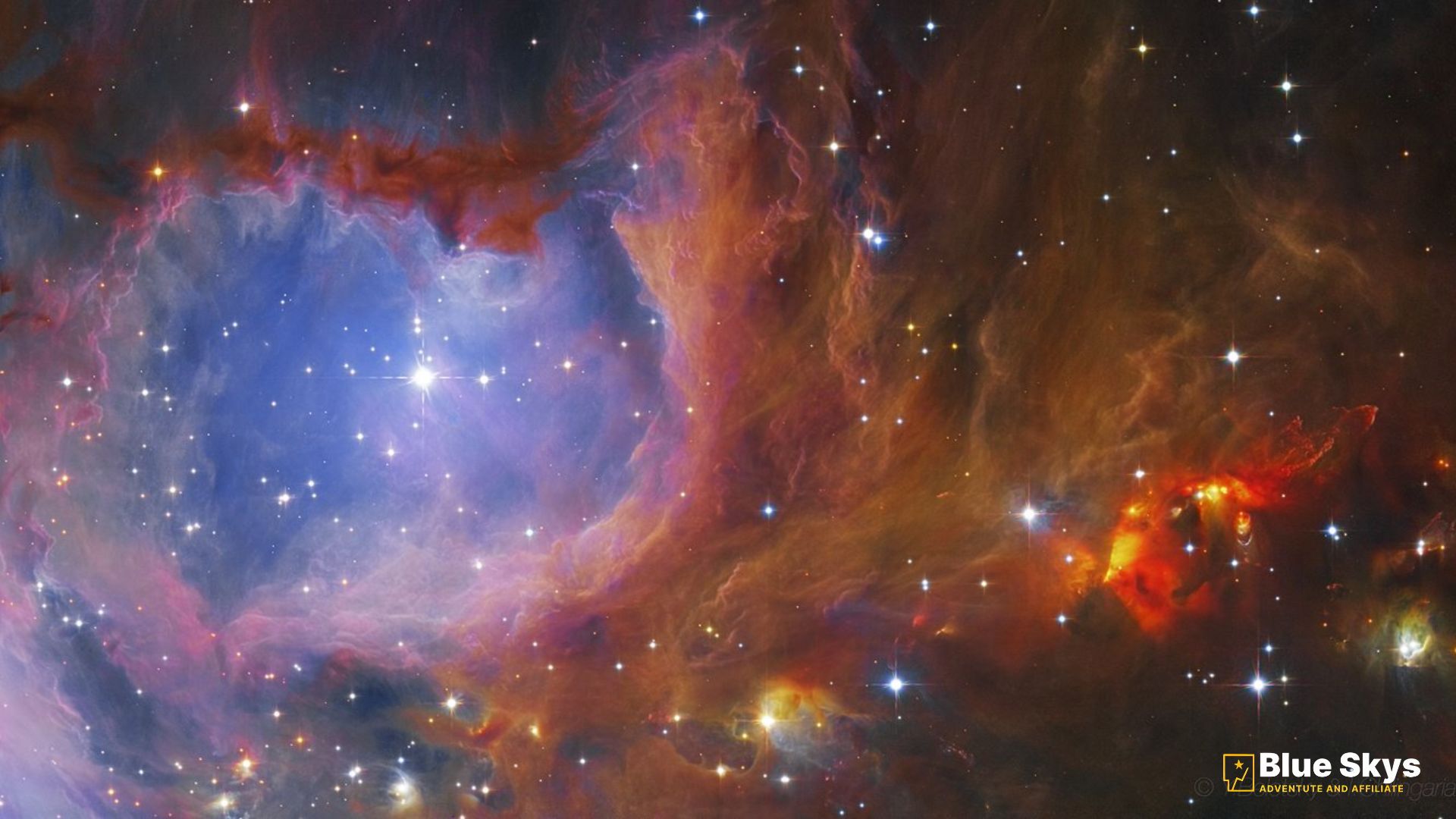
Orion is a spectacular constellation not only for its shape but for the bright, young stars and the enormous star-forming regions it contains. These regions contain incredible Nebulae such as M42 and the Horsehead.
Orion: A Massive Stellar Nursery
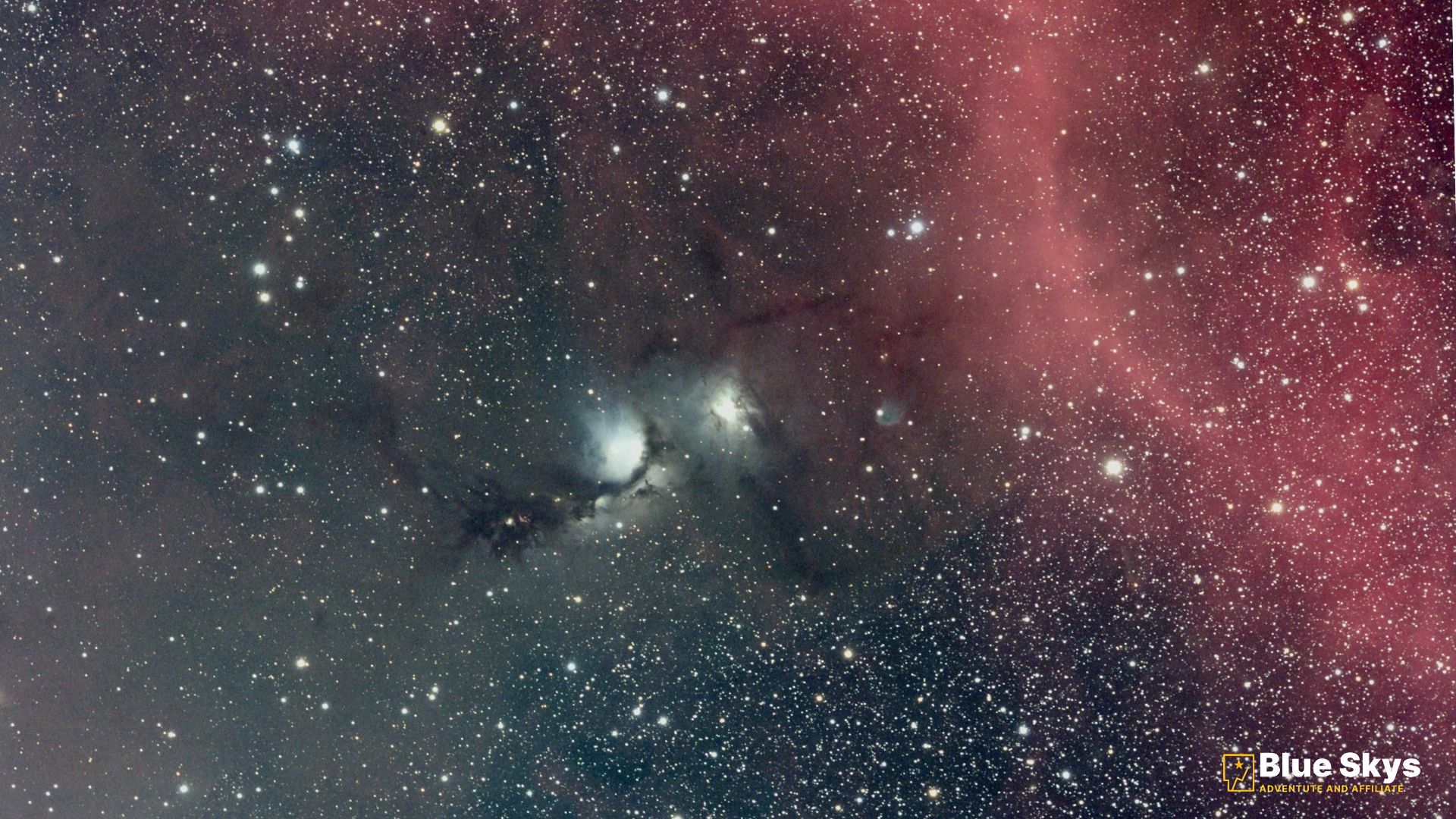
Orion is not merely a collection of stars; the entire constellation is embedded within the vast Orion Molecular Cloud Complex, a massive region of dust and gas that stretches across more than half of the figure. This complex is the closest region of massive star formation to Earth, containing stellar landmarks like the Horsehead Nebula, the Flame Nebula, the emission nebula Barnard’s Loop, **De Mairan’s Nebula (M43)**, and the reflection nebula Messier 78.
The Major Stars and Supernova Potential
The constellation is defined by the striking color and brightness contrast of its two main stars:
Betelgeuse (The Right Shoulder α Orionis): This colossal red supergiant, located at Orion’s eastern shoulder, exhibits a distinctive orange-red hue, making it easily identifiable with the naked eye. It is incredibly massive (14–19 solar masses) and is in the final, unstable phase of its life. Astronomers hypothesize that when it finally collapses into a supernova. Which could happen at any moment. The resulting explosion would be as bright as the half-moon and visible even during the day for over three months. This spectacular event would be so luminous it could cast shadows at night. Betelgeuse’s dimming episodes, such as the major event in late 2019, are linked to traumatic outbursts where the star blew off material, signaling its chaotic stellar evolution.
Rigel (The Left Foot β Orionis): As the brightest star in Orion and the seventh brightest in the night sky, Rigel is a luminous blue-white supergiant. Rigel’s name derives from an Arabic term meaning “the left leg of the giant”. Its intense blue-white glow is a result of an extremely hot surface temperature. Rigel is approximately 860 light-years away.
Secondary Anatomy: The constellation’s remaining primary stars are the blue-white Bellatrix (the left shoulder) and Saiph (κ Orionis), which marks Orion’s right knee.
Orion’s Belt Stars: The three central stars—Alnitak, Alnilam, and Mintaka—are all massive blue supergiant stars. Mintaka (δ Delta Orionis) is actually a complex quintuple star system located closest to the celestial equator, while Alnitak (ζ zeta Orionis) is a triple star system located at the eastern end of the belt.
Orion’s Sword: The Great Nebula (M42) and De Mairan’s Nebula (M43)
The Great Orion Nebula (M42) visible as a purple glow in Orion’s Sword.
Hanging below the Belt is the asterism known as Orion’s Sword. Which contains the most spectacular deep-sky objects in the constellation. The middle “star” in the sword is a bright, fuzzy patch: the Great Orion Nebula (M42). If you’re wondering what is the best time to see the Orion Nebula? See the section below on peak visibility for optimal viewing clarity.
M42: The Great Nebula: M42 is the closest region of massive star formation to Earth, located approximately 1,344 ± 20 light-years away. Older texts often call it the Great Nebula in Orion. Spanning 24 light-years and possessing a mass 2,000 times that of the Sun, this immense region is where stars and planetary systems are actively forming. Astronomers have directly observed fascinating features here, including an edge-on protoplanetary disk resembling an “interstellar Frisbee” around a newborn star—a process similar to how our own solar system formed 4.5 billion years ago. The central region features the Trapezium Cluster, a group of four tightly packed young, massive stars that illuminate the entire nebula.
The Great Orion Nebula (M43) visible as a Golden Brown glow in Orion’s Sword.
M43: De Mairan’s Nebula: Just north of the main M42 structure, separated by a dark lane of dust, is Messier 43 (M43). Also known by the Low-Competition name De Mairan’s Nebula (or NGC 1982), M43 is a distinct, miniature star-forming region. While fainter than M42 (apparent magnitude 9.0), M43 is visible through small binoculars and telescopes and serves as a vital component of the larger Molecular Cloud Complex.
When is the Best Time to See Orion from?
Orion is a winter constellation in the Northern Hemisphere and a summer constellation in the Southern Hemisphere. Or more percisely, its visibility shifts seasonally:
Peak Viewing Time: The constellation is visible in the evening sky from November to May. But its peak visibility occurs between November and February.
In Mid-Northern Latitudes (e.g., North America, Europe): Orion is best seen on winter nights, dominating the southern sky. Around 9:00 PM in January, the constellation reaches its highest point in the sky (the local meridian).
In Southern Latitudes (e.g., Australia, South Africa): Orion is prominently visible during the summer evenings.
Near the Equator: In countries close to the equator, Orion can appear nearly overhead around midnight in December.
Orion is generally in the daytime sky from May to July and thus invisible during that period at most latitudes.
How to Maximize Your View (Naked Eye and Binoculars)
To fully enjoy objects like the Orion Nebula and other deep-sky targets:
Use Averted Vision: Since the M42 Nebula is faintly visible to the naked eye. Try looking slightly away (to the left or right) of the area you are targeting. This technique, known as averted vision. It utilizes the parts of your retina most sensitive to gray tones and darkness, helping you perceive dimmer objects.
Low Power, Wide Field: Even simple binoculars offer a spectacular “lost in space” view of the Orion Nebula. And the surrounding star clusters. Low magnification and a wide field of view are often better than high magnification for viewing large, diffuse targets.
Ready to Hunt? Your Next Stargazing Adventure
The Legacy of Orion: Myths Across Cultures
The constellation’s visibility across the celestial equator meant it held great significance for cultures around the world.
The Egyptians: The three stars of the Belt were seen as the resting place of the soul of the god Osiris.
The Mayans: The Orion Nebula (M42) was believed to be the “cosmic fire of creation“.
The Arabs: The star Rigel derives its name from an Arabic term meaning “the left leg of the giant“, and Hatsya (at the tip of Orion’s Sword) is sometimes known by the Arabic name Nair al Saif, meaning ‘bright one of the Sword‘.
Global Variations: The Maori people of New Zealand saw the constellation as Te Waka o Tamarereti, a great celestial canoe, used for navigation and marking seasonal changes for fishing and planting. In India, it is Mriga (the Deer).
The Orion the Hunter Constellation serves as a perfect starting point for any stargazing journey. Its brightness and distinct shape make it an invaluable aid for star-hopping to fainter targets. Using its belt to point the way to other major stars like Sirius and Aldebaran.
Even without a telescope, you can greatly enhance your view by using a pair of simple binoculars. Which will reveal the cloud-like nature of the Orion Nebula and the countless stars surrounding it. For the best possible naked-eye viewing experience, find a Dark Sky Destination away from bright lights.
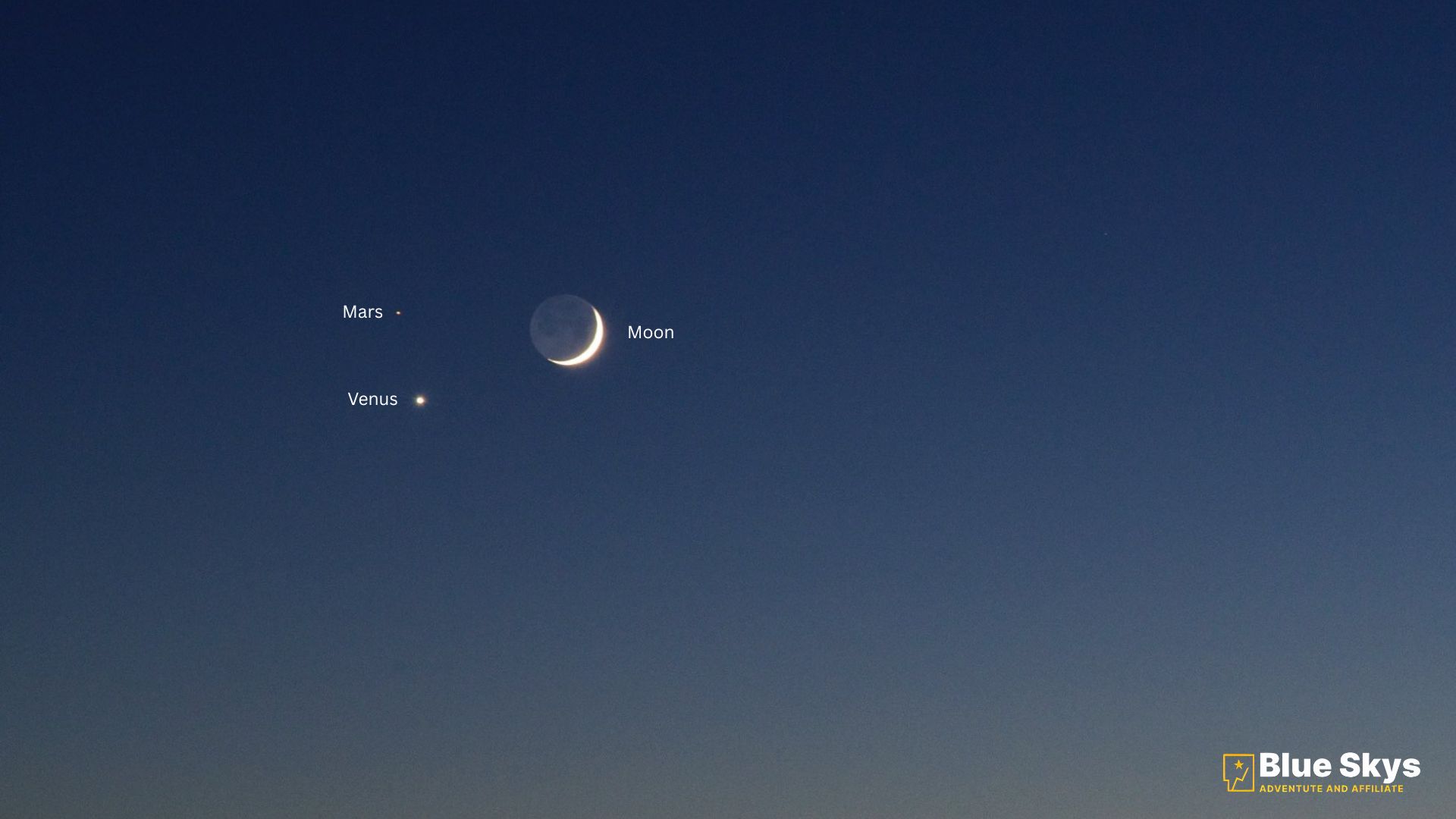
You did’t miss a “perfect line of planets” in June – because it was never there. What you might have forgotten, or perhaps want to relive, are the nights when the sky truly came alive: Mars illuminating the night from dusk till dawn in January, a stunning seven-planet arc stretching across the horizon in late February, Saturn Sharpening its rings to a delicate edge in spring, and Venus and Jupiter nearly touching at dawn while meteors streaked through their glow. This is the straightforward, high-impact guide to what really happened – and the exact steps to make next year’s alignments your most unforgettable nights.
A stunning view of Mars, Venus and moon with naked eye.
What really happened in 2025: the verified highlight
January — Mars at opposition (mid‑January): Mars rose at sunset and blazed all night, offering its brightest views in years. Small telescopes teased out polar caps and dusky markings while naked‑eye observers enjoyed a red beacon dominating winter skies.
Mars shone all night in January as it reached its brightest point in years.
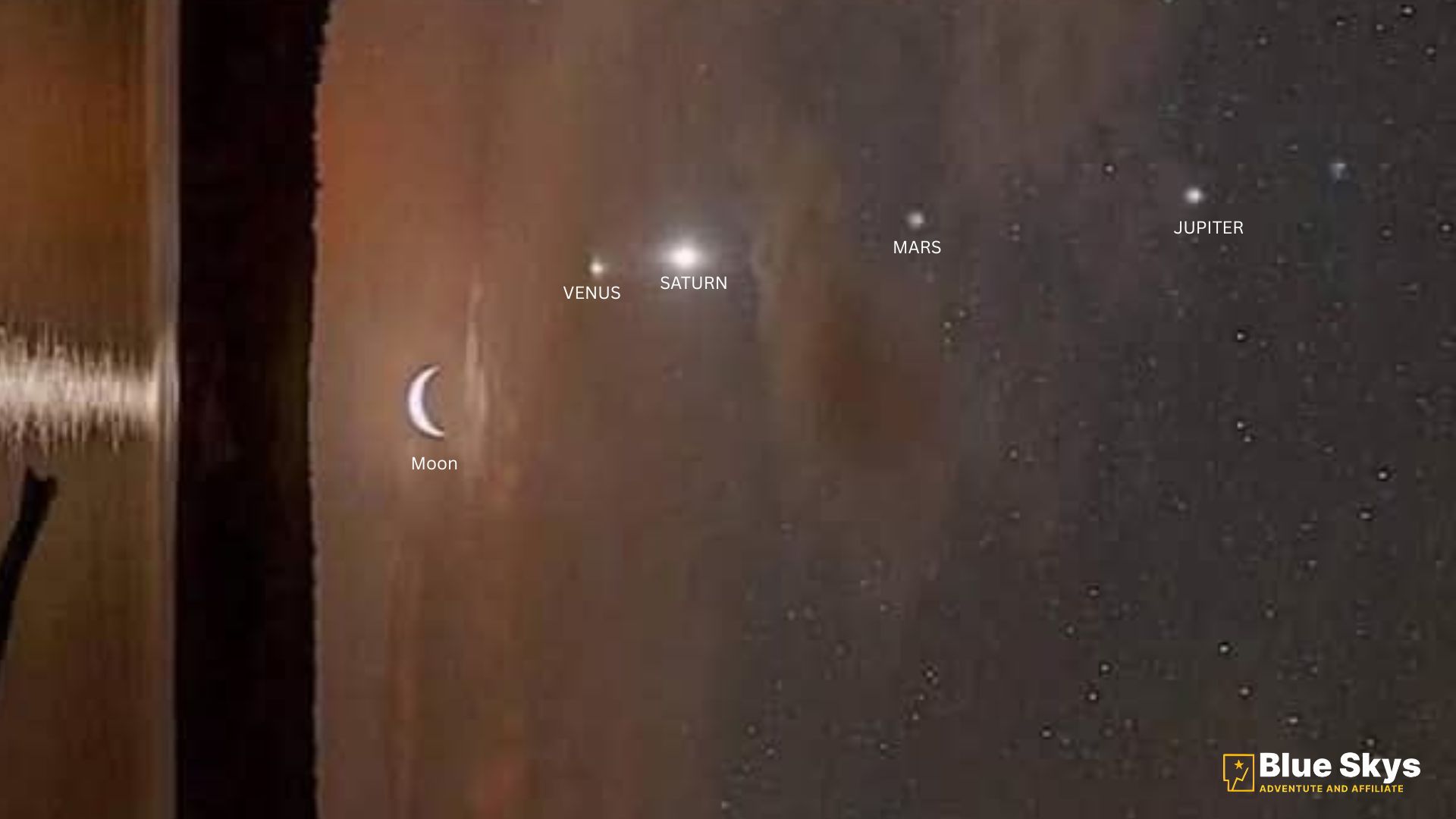
Late February — The seven‑planet parade (Feb 23–28): A genuine multi‑planet arc: Mercury, Venus, Mars, Jupiter, Saturn, Uranus, Neptune. After sunset, the lineup stretched low in the west. Mercury and Saturn hugged the horizon; Uranus and Neptune needed binoculars; the rest were naked‑eye showpieces.
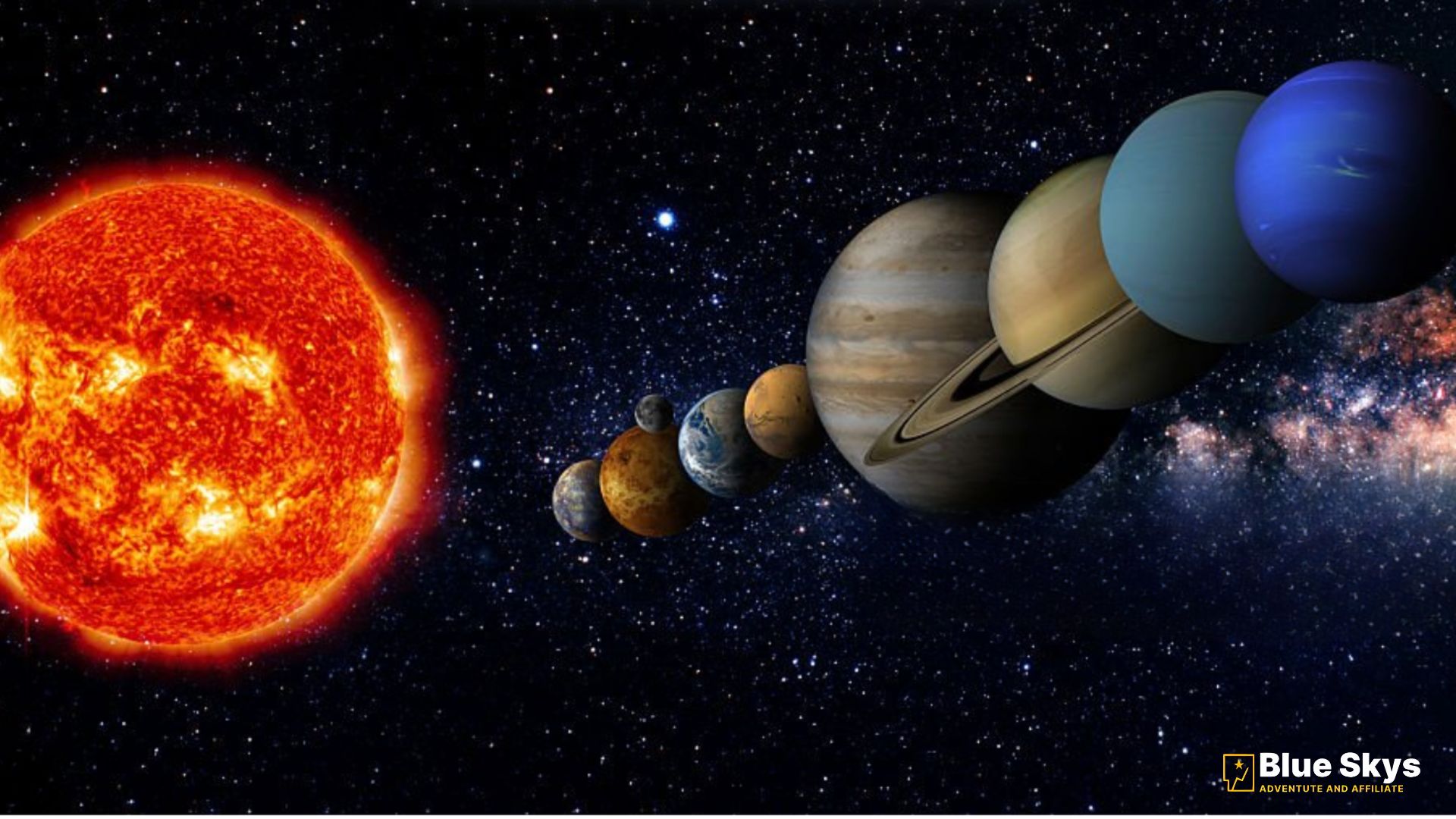
A visual overview of the real planetary parade events that occurred.
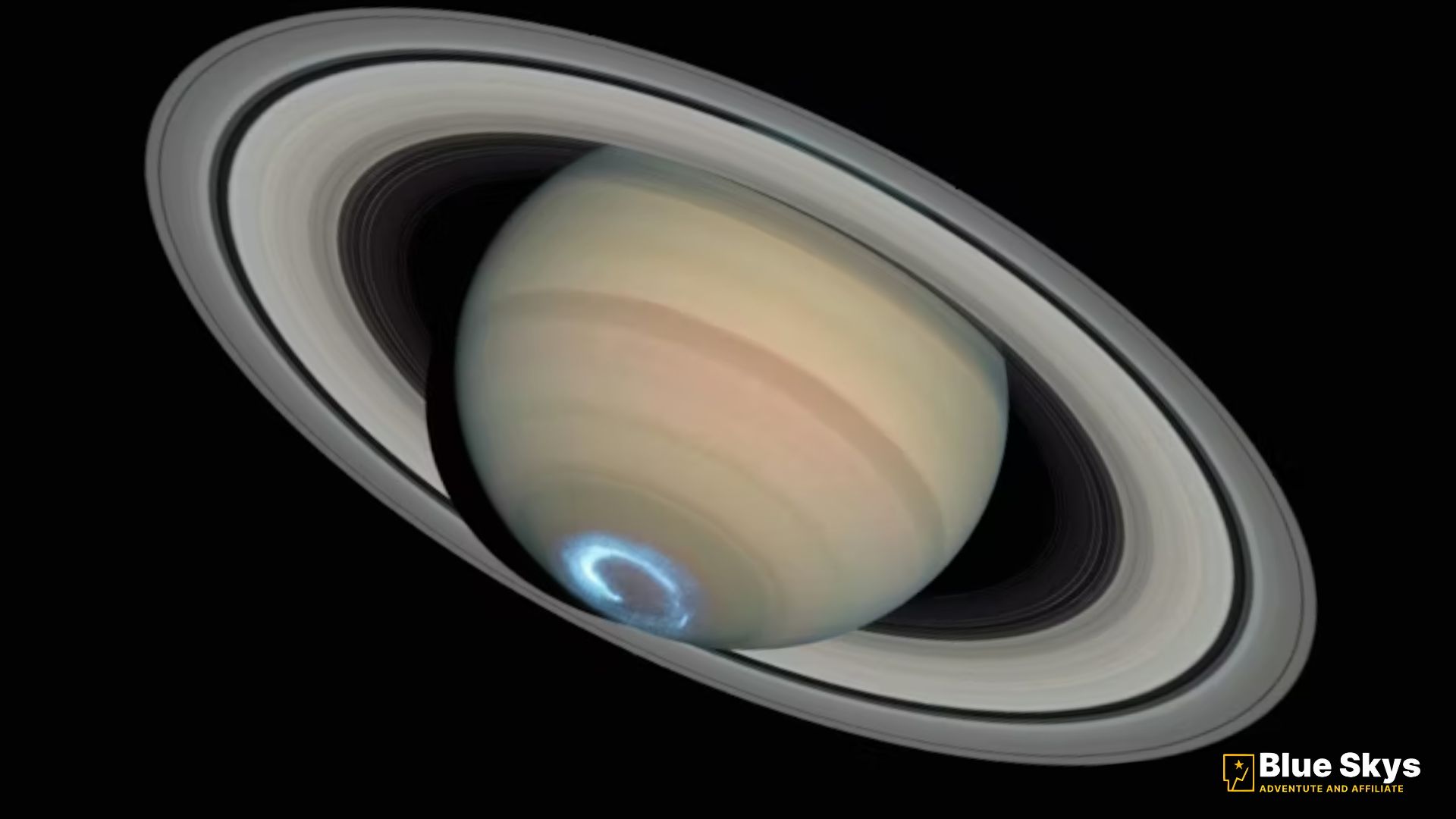
March–April — Saturn’s rings edge‑on: Geometry turned Saturn’s rings into a paper‑thin line, transforming its familiar look in telescopes. A rare aesthetic shift that rewarded patient observers and imagers.
In March and April, Saturn’s rings tilted into an edge-on position, altering its appearance dramatically. Credit: NASA Hubble Space Telescope
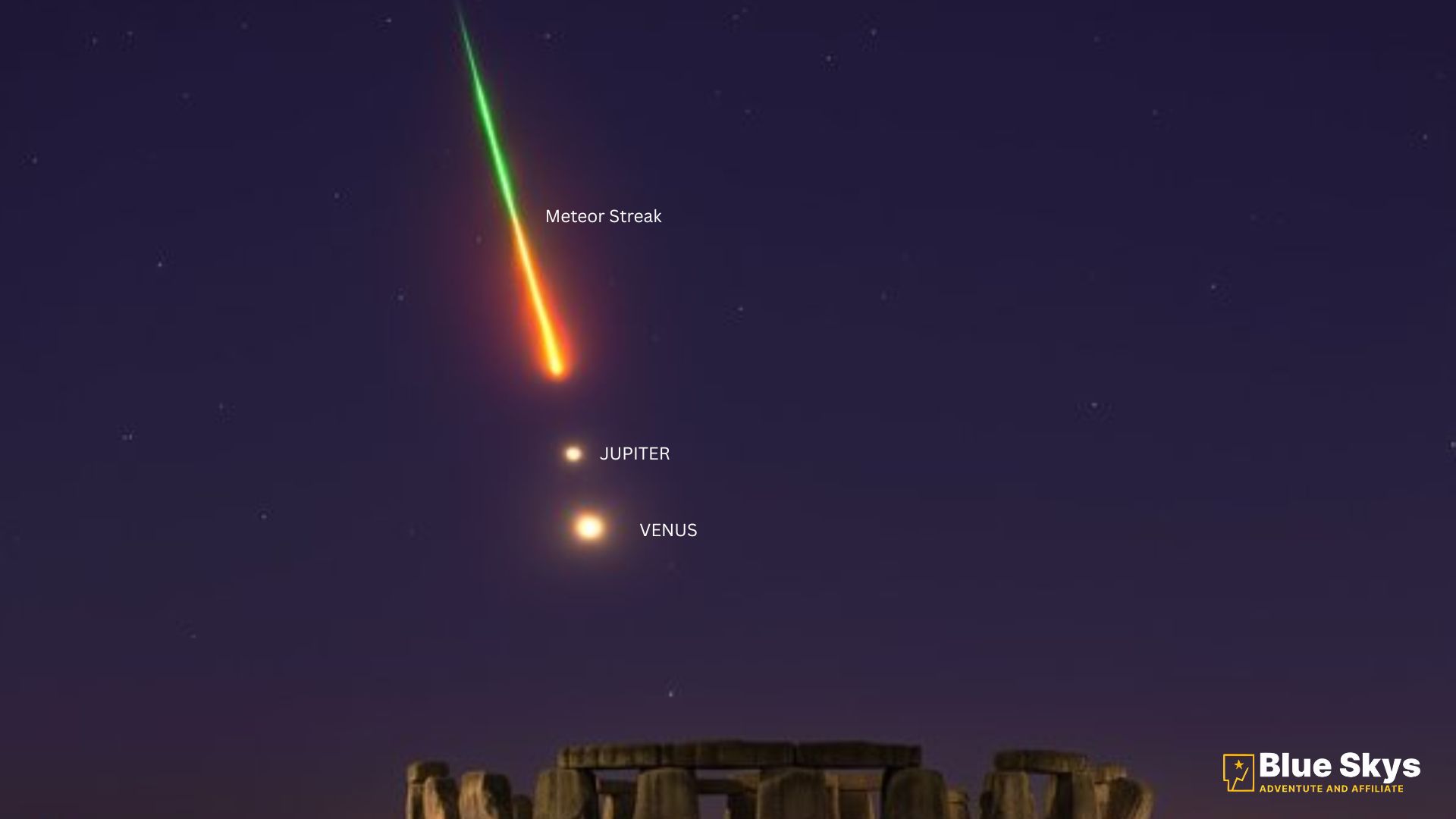
August 12 — Venus–Jupiter dawn pairing (+ Perseids):
The two brightest planets tightened to roughly a degree before sunrise—photogenic, dramatic, and perfectly timed as Perseid meteors stitched light across the scene.
The vivid meteor streak above Stonehenge is likely a Leonid meteor, active from Nov 16–18, known for fast, colorful trails
November — Southern Hemisphere treat:
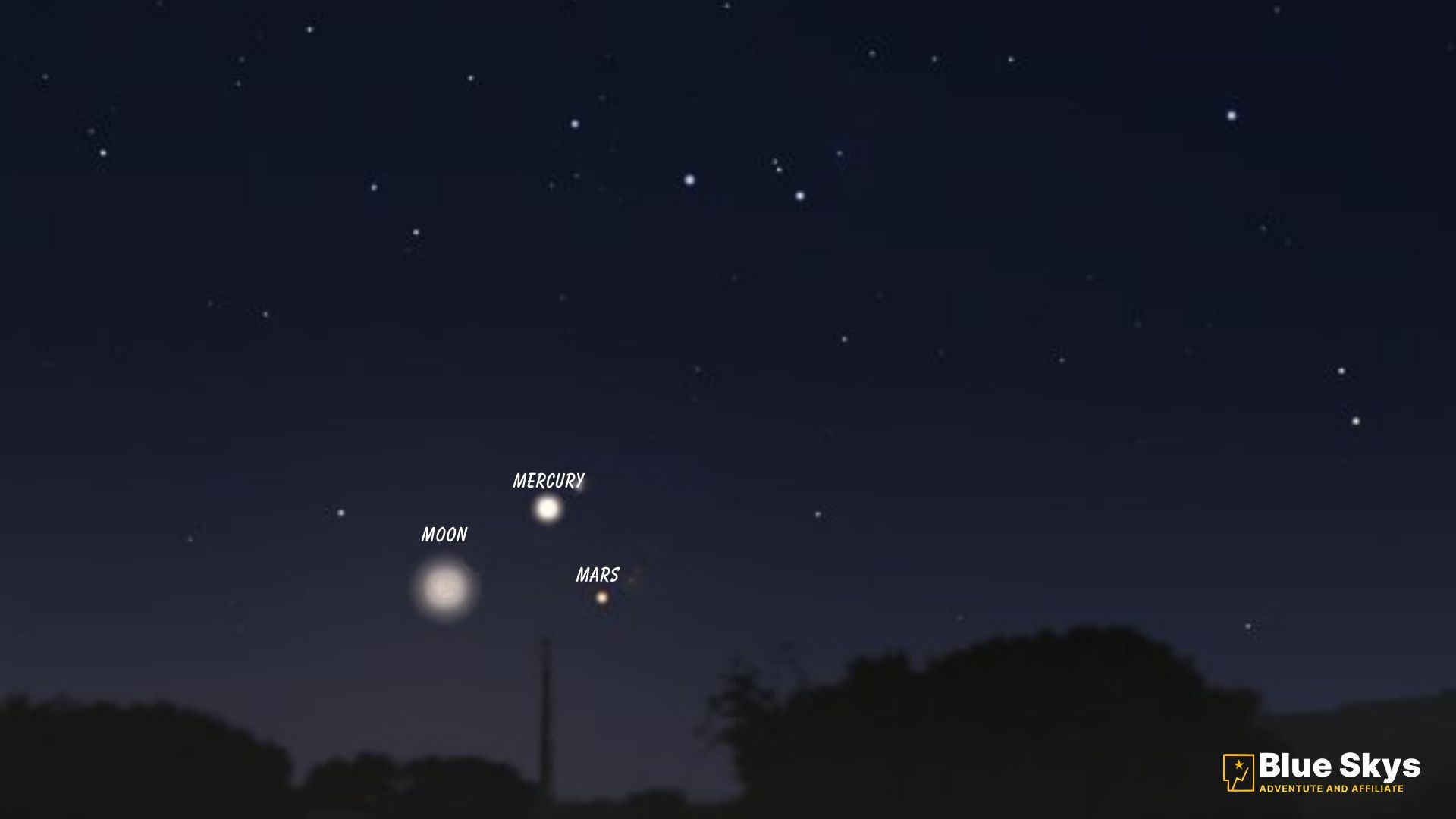
Mercury and Mars paired high after sunset for Australia, New Zealand, South Africa, and parts of South America—an easy, golden‑hour show with big public‑outreach appeal.
Southern sky observers enjoyed a bright pairing of Mercury and Mars in November.
Why the June rumor exploded — and how to avoid bad sky takes
Images without context: Simulated sky maps and wide photos shared with no date, time, or latitude misled millions.
Clickbait headlines: “See all the planets at once!” outran corrections.
Global claims for a local sky: Visibility depends on hemisphere, horizon, and timing—no single map fits everyone.
Fast filter: If a post lacks the exact UTC date/time and a location/hemisphere note, treat it skeptically and verify before sharing.
Evergreen guide — how to plan any planetary event
A visual overview of the real planetary parade event.
Tools that actually help
Naked eye: Bright planets and close pairings are easy and rewarding.
Small telescope: For Saturn’s rings and hints of Mars surface detail.
Planetarium app: Confirm what’s above your horizon at your location and time.
Pre‑event checklist (arrive prepared)
Horizon: Know your western/eastern clear view for that event.
Darkness: Faint planets need dark skies—plan the drive.
Timing: Show up 30–60 minutes early; let your eyes adapt.
Gear: Tripod, warm layers, printed finder chart, spare batteries, snacks
60‑second verification (no more confusion)
Open your planet app, set the date/time and location, and check the horizon view. If the planets sit below your horizon for that moment, the claim doesn’t apply to you.
There are constellations you stumble across by accident — and then there’s Leo, the one that almost announces itself.
Every spring, the Lion climbs into the eastern sky, bold as a sunrise. If you’ve ever tilted your head back on a cool March evening and spotted a backwards question-mark of stars curling into the sky, you’ve already seen Leo’s proud head. And if not? Consider this your invitation.
This guide blends practical stargazing, myth & history, and deep-sky exploration — with tips whether you’re looking with naked eye, binoculars, or a telescope. If you’ve ever wanted to track constellations, photograph galaxies, or just feel closer to the sky, Leo is the perfect companion.
Why Leo Matters in the Night Sky
Leo isn’t subtle — and that’s why astronomers love it.
Easy to find
Bright stars
Rich galaxy fields (including the famous Leo Triplet)
Cornerstone of spring stargazing
It’s a constellation that invites everyone — beginner to seasoned observer — to slow down, look up, and let curiosity do the rest.
⭐ How to Find Leo Constellation
Best Season
Hemisphere
Best Viewing Time
Spring
Northern
February – May (around 9–11 PM)
Autumn
Southern
August – October (low in north)
📌 Peak moment: Mid-March evenings — Leo stands almost overhead in dark skies.
Star-Hopping Guide
The famous Leo Triplet — a trio of galaxies showcasing cosmic structure and dust lanes.
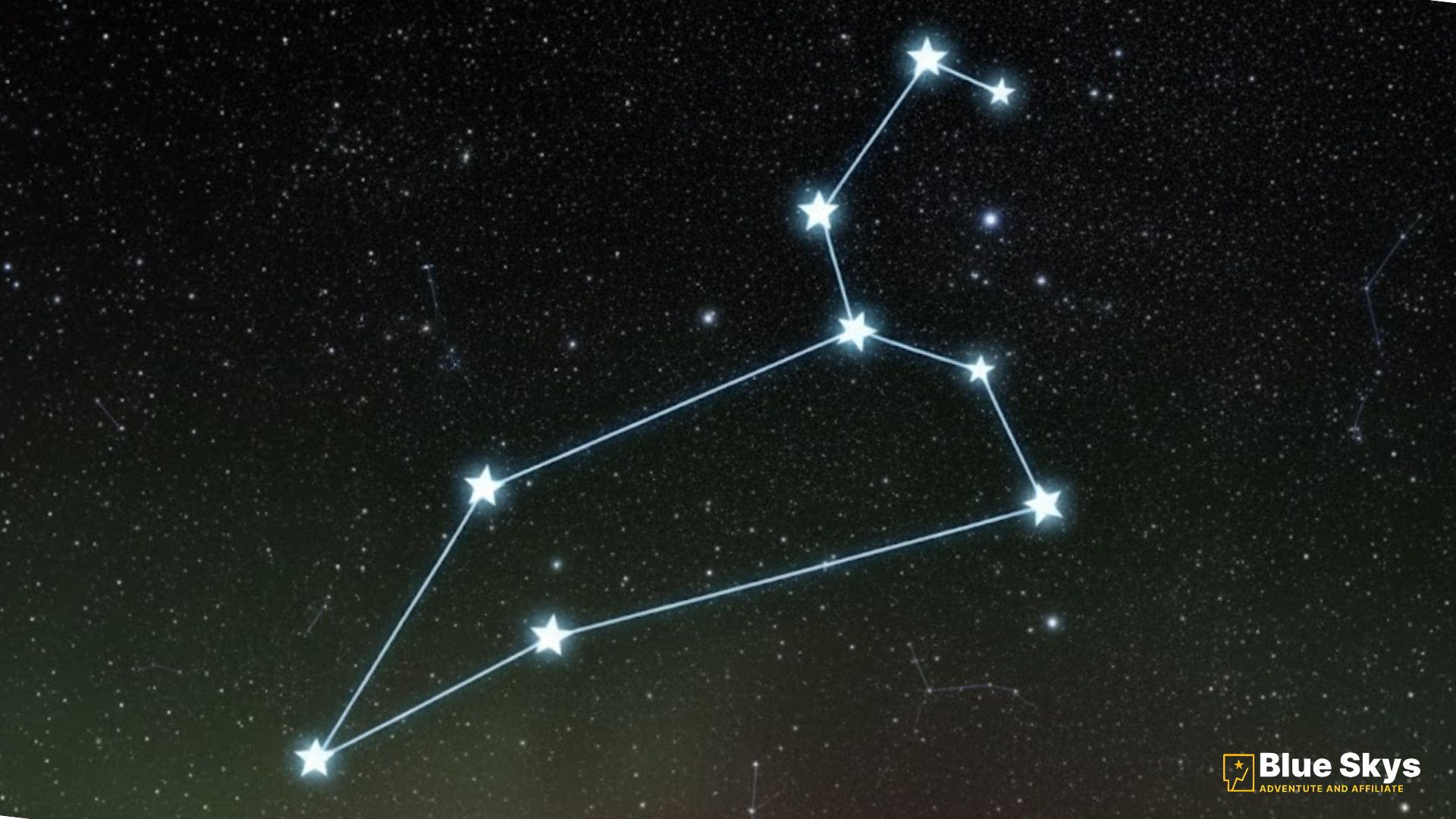
Start with the Big Dipper. Trace a line from the Dipper’s handle back toward the horizon — you’ll land on the Sickle, Leo’s dramatic head and mane.
The sickle shape looks like:
✔ backward question mark ✔ lion’s mane sweeping back ✔ hook of bright stars anchored by Regulus
Follow the Sickle to the right — you’ll see a long triangle forming the Lion’s hindquarters and tail.
Even in light-polluted skies, Leo is one of the most recognizable zodiac constellations.
🌟 Key Stars in Leo: Regulus (Alpha Leonis)
Nickname: The Heart of the Lion
Magnitude: ~1.35
Type: Blue-white main-sequence star
Distance: ~79 light-years
Fun fact: Spins so fast it bulges at the equator
A star of kings — literally. Ancient cultures used Regulus for royal astrology. Today, it’s an anchor star for spring alignment.
Some years deliver only ~15 meteors/hour. Others? The sky tears open — 1833, 1966, 2001 — legendary storms where meteors fell like rain. Even average years feel like whispers from cosmic history.
📖 Myth & Meaning
In Greek mythology, Leo represents the Nemean Lion, a beast no weapon could harm — until Hercules defeated it in his first labor. The lion was immortalized in the heavens.
Across cultures, Leo symbolized:
Royalty
Courage
Solar power & spring renewal
It’s one of the oldest recognized constellations, tied to agriculture, timekeeping, and navigation for thousands of years.
🔭 Viewing Leo: Beginners to Pros
Naked Eye
Find the Sickle first
Follow the body to Denebola
Notice the size — Leo fills a wide patch of sky
Binoculars
Algieba double star
Star fields around the Sickle
M66/M65 on a very clear night
Telescope
Target
Equipment
Algieba double star
80mm+ scope
M66 & M65
4-inch scope or better
Leo Triplet full detail
8-inch scope + dark skies
📸 Astrophotography Tips for Leo
Capture the Sickle arc
Use 50mm to 135mm lens for constellation framing
Track for long exposure galaxy shots
Shoot March–April for best clarity
Visual anchor: Regulus as leading star
For galaxy imaging: ISO 800–1600, long exposures, stacking recommended.
🧭 Coordinates, Visibility & Path
Right Ascension
Declination
10h 30m
+15°
Visible between latitudes +90° to −65° — truly global.
🌱 Why Leo Is a Gateway Constellation
If you’re learning the sky, Leo helps you:
Build star-hopping confidence
Transition from winter giants (Orion) to spring galaxies
Start deep-sky hunting
Connect seasonal movement of the heavens
It teaches patience, orientation, and reward — three pillars of stargazing.
🌌 Final Thoughts: Following the Lion
Every spring night carries a different mood. Some skies feel soft and quiet. Others shimmer with promise. But when Leo rises, the night feels alive — bold, ancient, certain. Trace the Sickle. Find Regulus beating steady against the dark. Breathe in the cold air and remember: the sky isn’t a map to memorize — it’s a story to walk through. And Leo? Leo is one of the first pages worth turning. Clear skies, and may your path always find the lion.
Across spring skies, the Maiden rises — guiding our eyes from a single star to a city of galaxies.
Virgo isn’t just another patch of stars — it’s a gateway to the deep universe. Home to Spica, one of the brightest stars in the sky, and the breathtaking Virgo Cluster of galaxies, this constellation bridges myth, stargazing, and cutting-edge cosmology.
Whether you’re stepping outside with binoculars or planning your first galaxy-season astrophotography session, Virgo rewards every level of sky-watcher.
⭐ Quick Guide
Question
Answer
What is Virgo?
A zodiac constellation, “The Maiden,” second-largest in the sky
Best time to see Virgo?
March–July (peak: April & May)
Brightest star?
Spica (Alpha Virginis)
Key deep-sky target?
Virgo Cluster — 1,300+ galaxies
Great for beginners?
Absolutely — easy star-hop from Arcturus
Northern or Southern Hemisphere?
Visible in both; higher in Northern spring
🌟 How to Find the Virgo Constellation
If you’re learning how to locate Virgo, start with a classic star-hopping route:
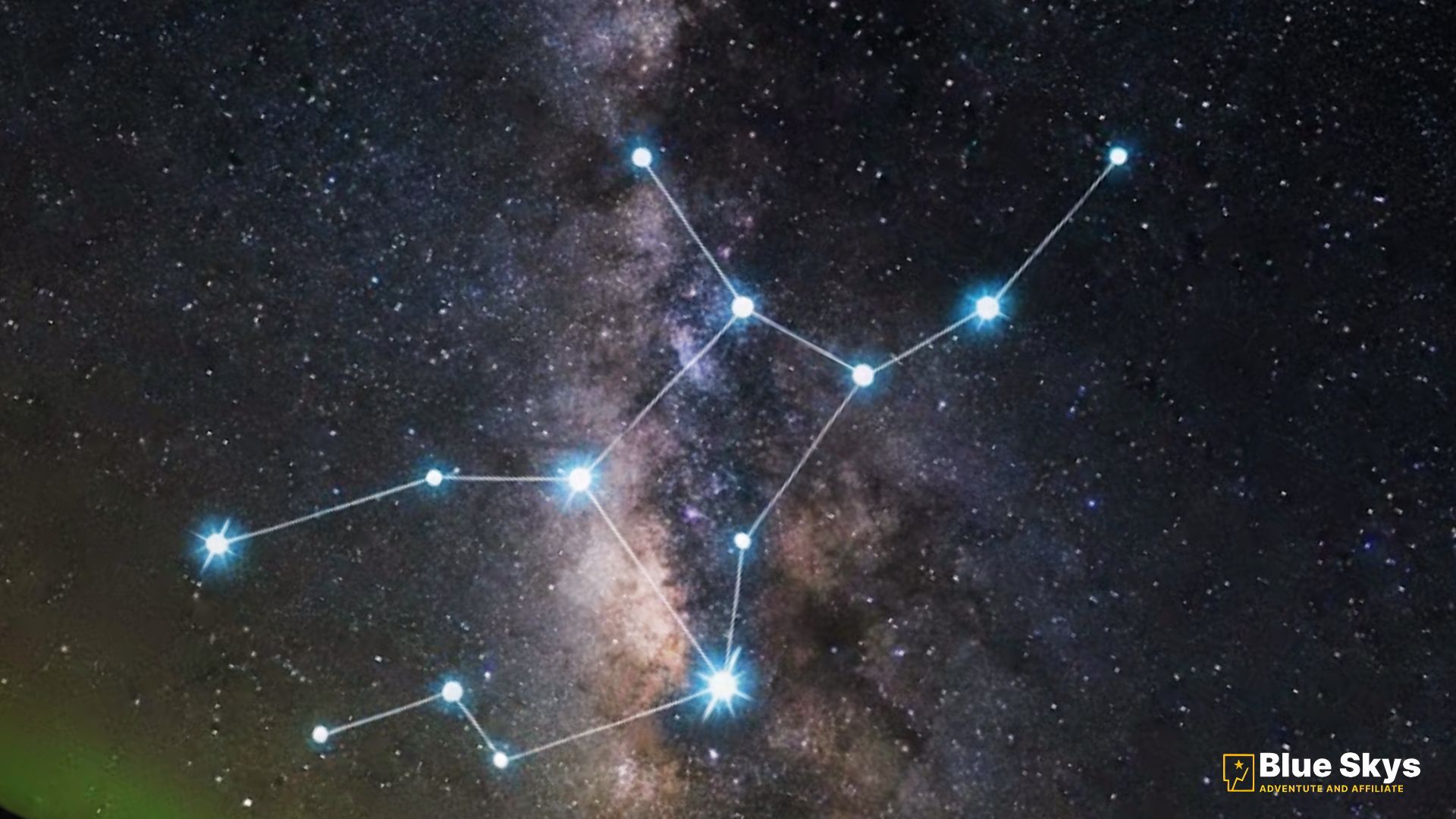
The Virgo constellation rising in the spring night sky, with Spica shining as its brightest star.
These galaxies lie ~55 million light-years away — yet visible from your backyard with a modest scope.
Best beginner galaxy hop: Start at Vindemiatrix → sweep west into the Virgo Cluster.
🔭 Equipment & Astrophotography Tips
Naked-eye: Easily spot Spica and Virgo’s Y shape in dark skies
Binoculars (8×42 / 10×50): Track bright stars across the constellation. Detect faint glows around M87 region (excellent practice)
Telescope (6″–10″): Resolved shapes of Messier galaxies. Try low sky-glow nights (Bortle 1–4 ideal)
Camera + Tripod (Beginner Astro): Lens: 35mm–85mm, ISO: 1600–3200, Shutter: 10–15 sec (w/o tracker), Tracker: Yes for Markarian’s Chain (2–3 min subs)
Shoot Virgo in April/May — darker spring skies = cleaner galaxy detail.
🌍 Cultural Story: The Maiden of Spring
In myth, Virgo is often Astraea, the goddess of justice and innocence — the last immortal to leave Earth during humanity’s fall from the Golden Age. Her star Spica represents the ear of grain — a symbol of harvest and rebirth. Across cultures, Virgo heralds sowing, growing, and renewal — the sky’s promise that life returns each year.
🧭 Virgo Fast Facts
Category
Info
Meaning
The Maiden
Brightness rank
Spica = Top 15 star
Constellation rank
#2 largest
DSOs
~1,300+ galaxies
Scientific claim
Center of Virgo Supercluster (our galactic neighborhood)
If there’s one constellation that captures the dramatic, unforgettable beauty of the night sky, it’s Scorpius constellation. You don’t need a star chart to find it; the celestial scorpion is one of the most vividly shaped patterns visible to the naked eye. With its long, curved body and the throbbing red giant at its core, Scorpius is more than just a figure—it’s a dynamic roadmap to the richest parts of our galaxy.
Known since the dawn of astronomy, this is one of the original twelve zodiac constellations, tracing the path of the Sun. The ancient Sumerians called it MUL.GIR.TAB, and for good reason: it’s absolutely unmistakable. Crucially for us, Scorpius lies directly along the plane of the Milky Way, making it a cosmic goldmine packed with stunning deep sky objects, clusters, and nebulae.
Let’s dive into the Scorpion’s domain and learn exactly how to find Scorpius constellation and its treasures.
Astrophysics Corner: The heart of the Scorpion marks a key location in the sky, positioned at approximately right ascension (RA) 16h 53m and declination (Dec) −30° 44′.
1. Finding the Scorpion: Your Seasonal Viewing Guide
To enjoy Scorpius, you just need to know when and where to look.
The Best Time and Location
The prime viewing period for Scorpius spans from May to September. However, it truly shines, rising highest in the late evening hours of July and August.
The Southern Hemisphere Advantage: If you live in the Southern Hemisphere (Australia, New Zealand, etc.), you’re incredibly lucky. Scorpius travels high overhead during your winter months. If you search for Scorpius visibility in July Southern Hemisphere, you’ll see why the sight is often called the “King of the Southern Sky.” It dominates the view, revealing breathtaking detail against the backdrop of the Milky Way’s central bulge.
The Northern Hemisphere View: For those of us north of the equator (above 40°N), Scorpius hugs the southern horizon. You need a clear, unobstructed view without trees or buildings. Look immediately after sunset during peak summer—it’s worth the effort!
Step-by-Step Identification: The Signature Hook
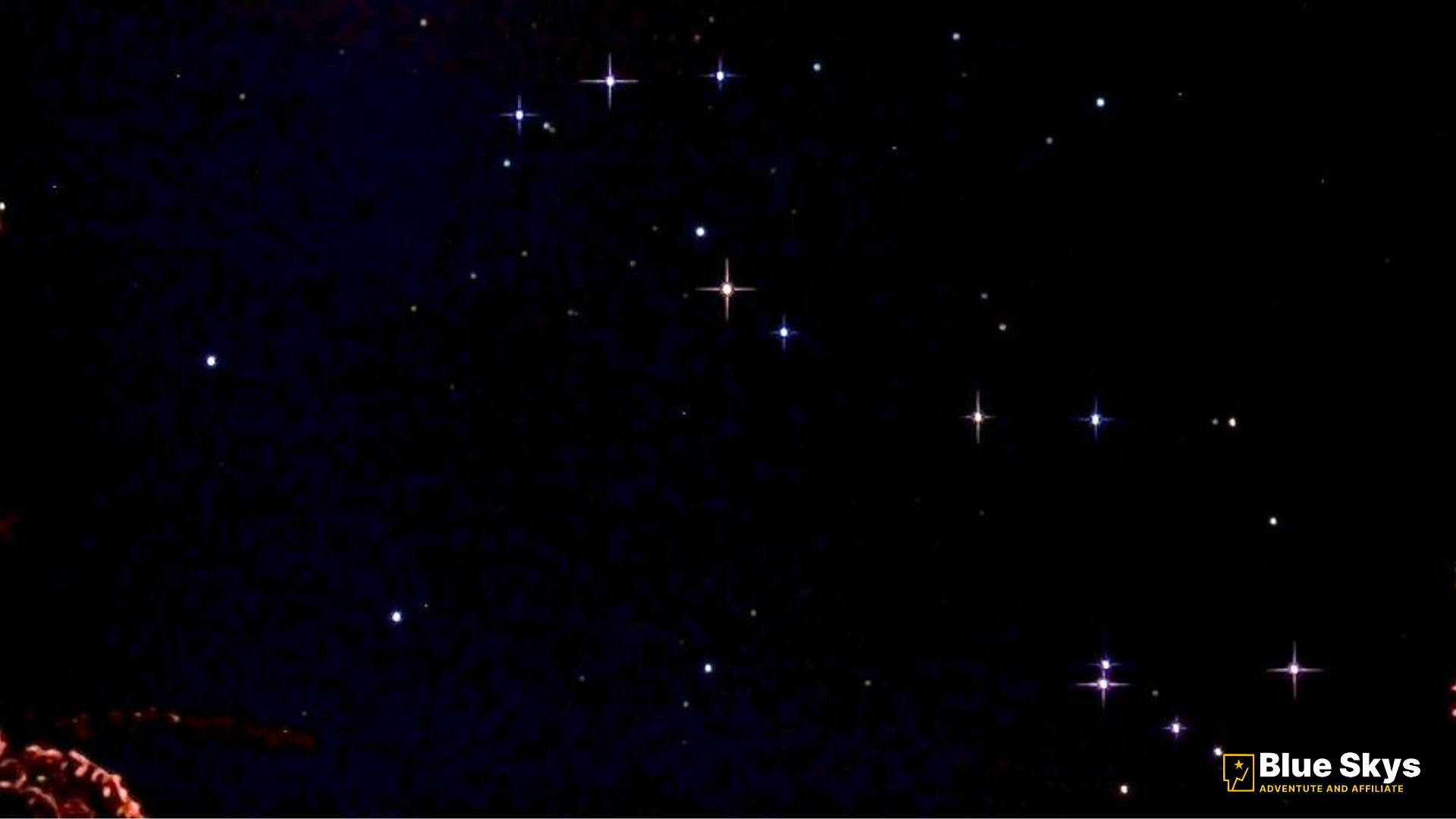
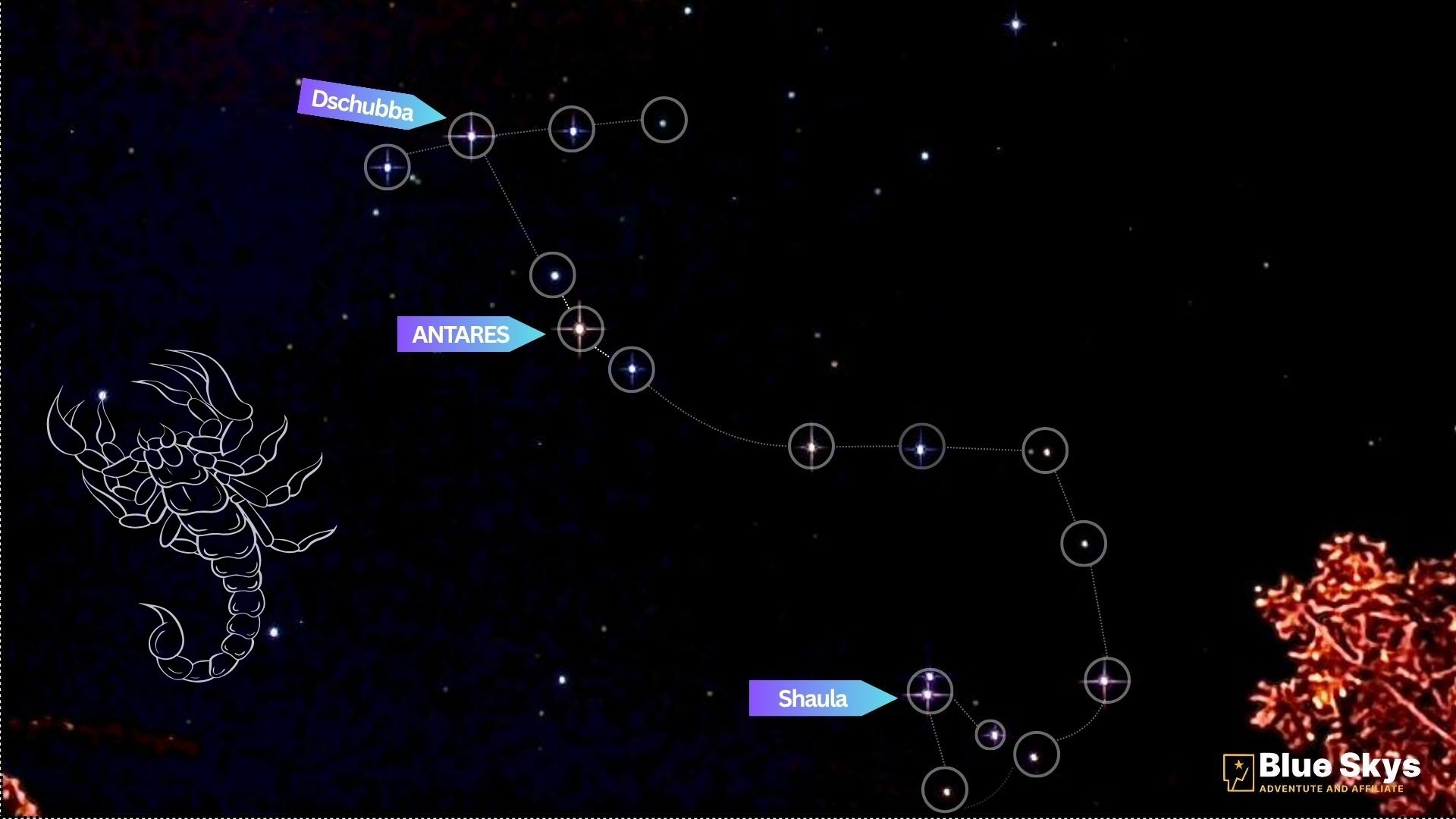
Illustrated star map of the Scorpius constellation, highlighting Antares, Dschubba, and Shaula — a Southern Hemisphere favorite for stargazers and astrophotographers.
Forget the star charts for a moment and look for this tell-tale shape:
Spot the Heart: Look south (or high overhead, depending on your latitude) for a star with a noticeable reddish-orange star color. This is Antares. It’s big, bright, and stands out.
Trace the Body: Starting at Antares, look west (to the right) to find a cluster of bright, hot, blue-white stars—this forms the Scorpion’s head, featuring Dschubba (Delta Scorpii) and Acrab (Beta Scorpii).
Follow the Stinger: The distinctive part! Follow the tail curving down and back up to the east (left). The very tip is marked by two gorgeous, close-set bright stars: Shaula and Lesath Scorpius stinger stars. This hook shape is what makes the Scorpion impossible to miss.
2. Antares: The Star at the Center of the Drama
The star Antares is the heart of the Scorpion and the undisputed focal point of the constellation.
Massive, Red, and Ready to Explode
When you look at Antares, you’re looking at a genuinely enormous, fading star. Its name, which means “rival of Ares” (or Mars), was earned because its deep, intense hue rivals the color of the Red Planet.
Here are the crucial Antares Scorpius facts:
Cosmic Scale: Antares is a red supergiant star, one of the largest and most luminous stars we can observe. If you replaced our Sun with Antares, its surface would extend past the orbit of Mars!
Distance and Classification: It lies approximately 550 light-years away. This giant is classified as Spectral type M1.5 Iab-Ib, which tells astronomers its low surface temperature gives it that characteristic red color.
The Hidden Companion: If you use a moderate telescope, look closely. You can spot Antares B, a faint, hot, blue-white companion star tucked right beside the giant. This spectacular color contrast—fiery red next to brilliant blue—is one of the night sky’s most rewarding visual targets.
The Intriguing Variability of Dschubba
While Antares gets all the fame, don’t overlook Dschubba (Delta Scorpii) in the head. This star is fascinating for advanced hobbyists because it is a known variable star.
If you’re looking for a fun, long-term personal astronomy project, tracking the Dschubba Delta Scorpii star variability over the course of several months offers a rewarding challenge—its brightness sometimes fluctuates quite dramatically, proving that even “fixed” stars are dynamic.
3. Deep-Sky Treasures: A Galaxy on Display
Because Scorpius is located in one of the most star-dense regions of the sky, it is the perfect hunting ground for deep sky objects. If you need a Scorpius deep sky objects list, look no further. This constellation is absolutely loaded with stunning targets for both the naked eye and binoculars.
Top Binocular Targets
These clusters are must-sees and make the Scorpion a favorite for those seeking Scorpius best stars for binocular observation:
M4 (NGC 6121): This beautiful globular cluster is the easiest to find; it sits just a single degree to the west of Antares. It appears as a fuzzy, bright ball and is a spectacular sight even in small binoculars.
M6 – The Butterfly Cluster: True to its name, this open cluster looks exactly like a butterfly with its wings spread against the vast blackness. It’s an accessible target for small telescopes and binoculars.
M7 – Ptolemy’s Cluster: So large and bright that Ptolemy himself recorded it in the 2nd century. It is easily visible to the naked eye under dark skies and appears brilliantly scattered across a binocular field of view.
Nebula Hunting
The Milky Way backdrop also offers amazing nebulosity. While they require a telescope and dark skies, targets like NGC 6334 (the Cat’s Paw Nebula) and NGC 6357 (the War and Peace Nebula) are star-forming regions that reveal stunning colors in long-exposure photographs.
4. The Ancient Rivalry: Scorpius and Orion Mythology
The constellation carries a powerful history of conflict that connects our ancestors to the stars. The Scorpius and Orion mythology astronomy tale is perhaps the most famous rivalry in the celestial sphere.
According to Greek legend, the great hunter Orion boasted that he would kill every animal on Earth. This arrogance angered Gaia (Mother Earth), who sent a giant scorpion to defeat him. The Scorpion succeeded, stinging Orion to death. As a consequence of this epic battle, Zeus placed both combatants in the sky, but on opposite sides of the celestial sphere.
This is why, to this day, you will never see the night sky together—as Scorpius rises in the east in the summer, Orion is setting in the west, forever fleeing the celestial scorpion.
5. Capturing the Beauty: Your Astrophotography Checklist
The density and color of this region make it one of the most sought-after subjects for astrophotography. If you want to know how to photograph Scorpius Milky Way, follow these practical steps.
Essential Settings for Capturing Scorpius
Gear Up: A standard DSLR or mirrorless camera with a fast, wide-angle lens (in the 14mm-35mm range) is perfect for capturing the constellation and the surrounding Milky Way core in a single frame.
Optimal Settings (Untracked): Use a high ISO between 1600 and 3200. To avoid star trailing, keep the shutter speed limited to between 15 and 25 seconds.
Frame the Heart: Position Antares and the central body of Scorpius in the center of your frame, ensuring the “stinger” and the dense star clouds of the galactic center are also included.
Go Deeper: If you have an equatorial tracking mount, you can take much longer exposures (3-5 minutes) to bring out the faint pink and blue nebulosity surrounding stars. For advanced work on individual targets, consult a detailed scorpius cluster astrophotography guide specific to objects like the Cat’s Paw Nebula.
Final Thoughts: The Scorpion Awaits
The Scorpius constellation is a masterpiece of the cosmos. Whether you’re drawn to the ancient story of its rivalry with Orion, the sheer scale of the Antares star facts, or the breathtaking number of deep sky objects within its curving reach, the Scorpion is a lifetime of discovery wrapped up in one magnificent celestial figure. Find a dark sky, grab your binoculars, and enjoy the view!
When the cold bite of winter settles in, look up. Two exceptionally bright stars dominate the winter night sky: Castor and Pollux shine side by side. They form the famous Gemini Constellation. Sky-watchers have known them for millennia as the Twins. Gemini is one of the twelve constellations of the Zodiac, and it’s a mesmerizing sight from December through April. It’s a constellation that anchors mythology, symbolizing unity and eternal brotherhood.
Gemini tracks the ecliptic plane. This is the cosmic highway where the Sun, Moon, and all the planets travel in our solar system. This beautiful blend of history and science makes it an incredibly rewarding target for your next night out.
Locating the Twins: Your Beginner’s Guide to Finding Gemini
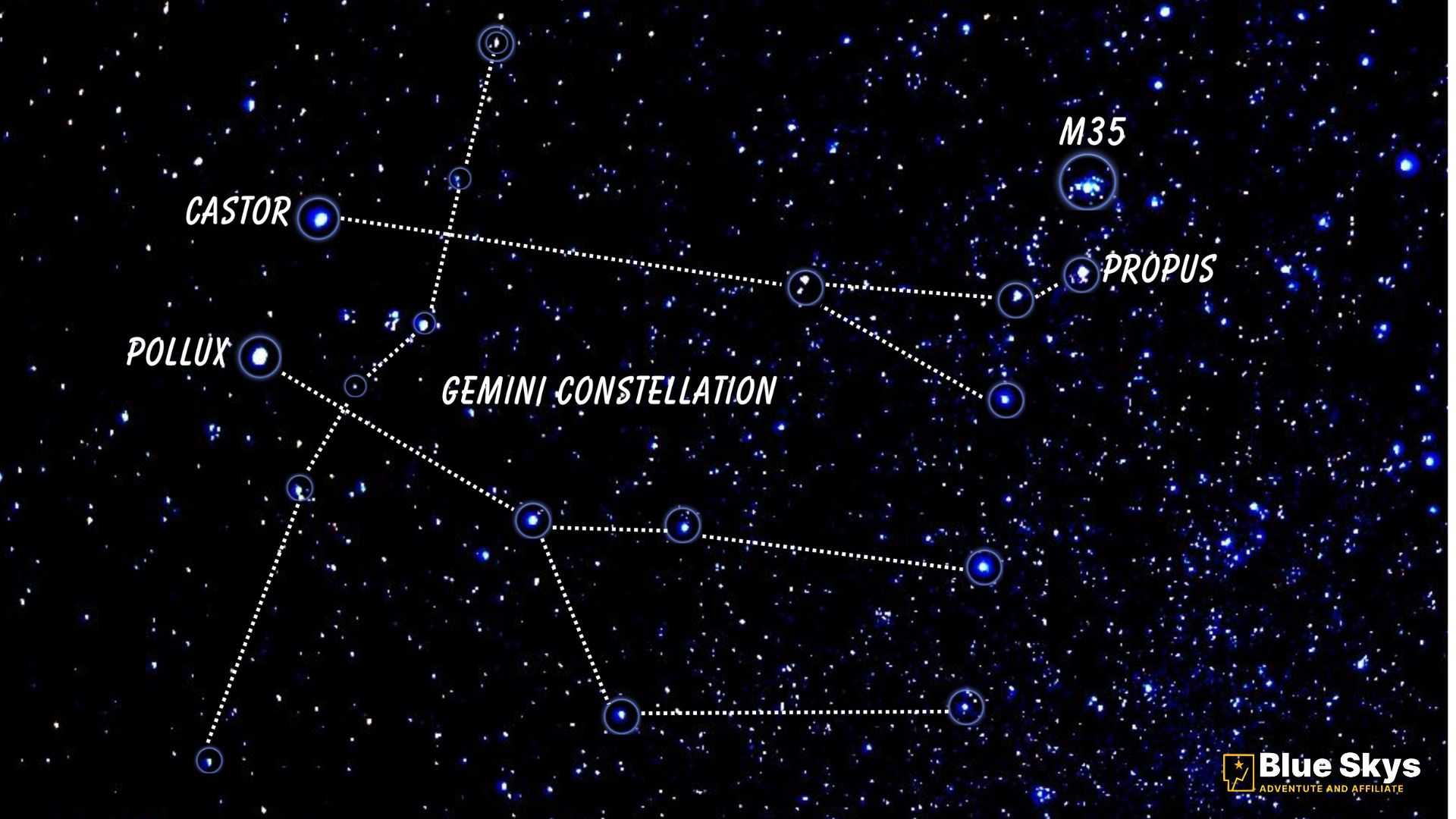
If you’re an amateur asking how to find the Gemini constellation at night, the good news is it’s surprisingly straightforward. You just need to know how to “star-hop.” Start by finding the three bright stars in Orion’s Belt. Draw an imaginary line from them, moving upward and slightly to the left, past the head of Taurus. The first two bright stars you hit mark the heads of the Twins. The constellation looks like two parallel stick figures stretching southward. This makes it easy to identify, even from a moderately light-polluted spot.
Gemini reaches its peak visibility—its highest point in the sky—around 10 PM in February. Northern Hemisphere observers see it best then.
Best Time to View: The prime season is December through April in the Northern Hemisphere.
Regional Visibility: If you are in the Southern Hemisphere (like Australia and New Zealand), the constellation appears low on the northern horizon during summer nights. Keep a Gemini constellation map printable handy to confirm your findings against the sky.
Castor and Pollux: Distinct Stars Behind the Twin Name
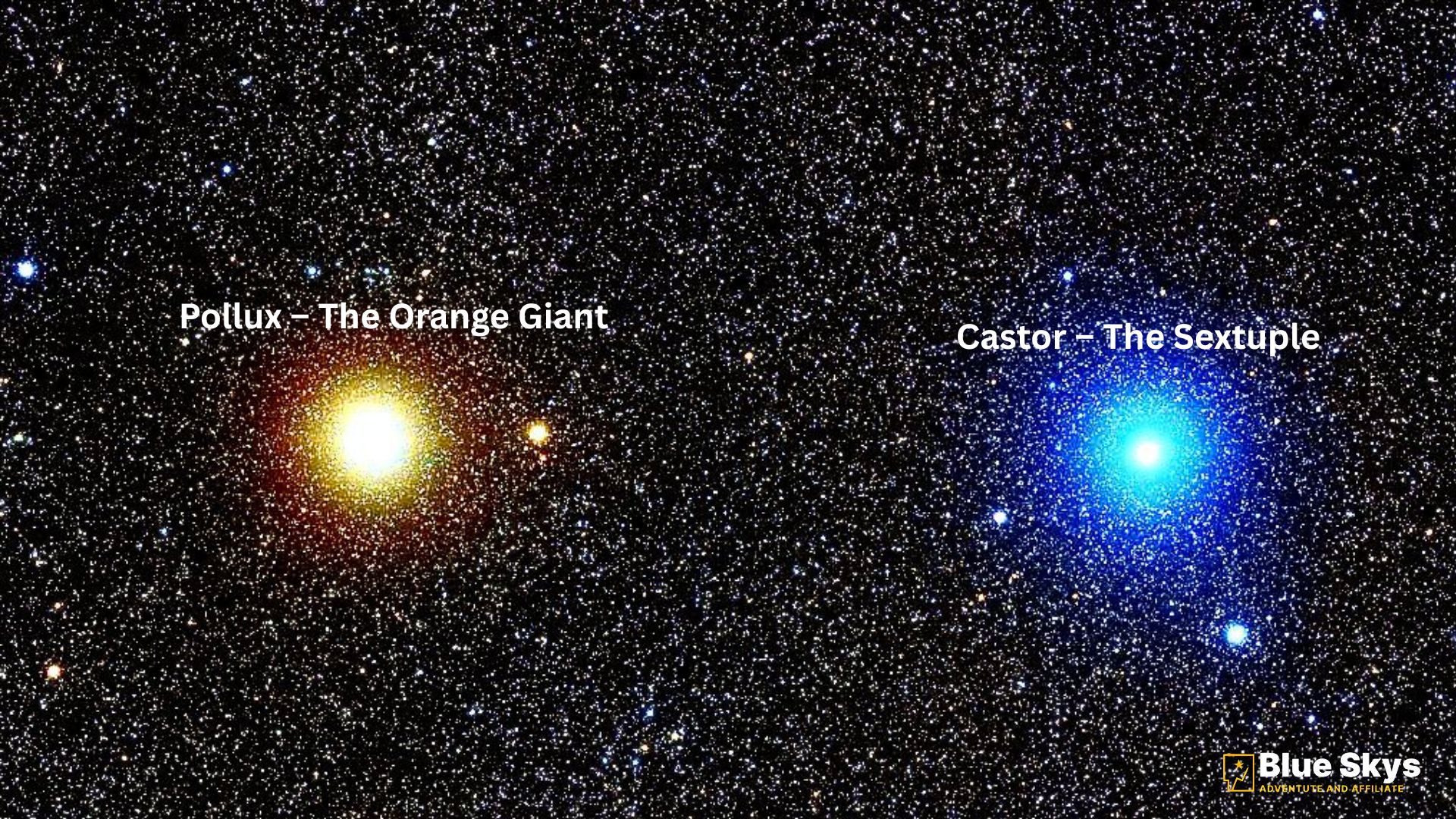
Compare the warm, orange glow of Pollux with the cooler white light of the complex Castor sextuple star system.
The stars Castor and Pollux may look like two peas in a cosmic pod. However, they differ dramatically when you examine their science. This is a common point of interest when looking to identify Castor and Pollux in the night sky.
Pollux – The Orange Giant with a Companion: Pollux is an old, large, and evolved orange giant star, measuring nearly ten times the diameter of our Sun. Its warm, golden glow makes it easy to distinguish from its cooler brother. Adding to its complexity, astronomers confirmed an exoplanet orbiting Pollux in 2006. This planet, Thestias (Pollux b), establishes Pollux as a significant beacon in exoplanet research.
Castor – The Sextuple Star System: It is a true sextuple star system—six stars gravitationally bound together. This intricate orbital dance makes Castor one of the most studied multiple star systems. It offers astronomers unique insights into stellar mechanics.
Deep Sky Treasures: M35 and the Clown Face Nebula
Beyond its brilliant points of light, the Gemini constellation hosts deep-sky gems, perfect for amateur astronomers exploring Gemini star cluster M35 visibility:
M35 (NGC 2168): This sparkling, bright open cluster holds hundreds of stars. Observers easily see it as a fuzzy patch of light, even through standard binoculars. It’s a rewarding target for observers.
NGC 2392 (Clown Face Nebula): This incredible planetary nebula requires a small telescope. It was famously known by the less favored historical name Eskimo Nebula. When you view it, its vibrant, shell-like structure truly gives it the appearance of a face surrounded by a parka hood.
The Geminid Meteor Shower: A Rock-Solid December Show
Perhaps the most thrilling event tied to this constellation is the Geminid Meteor Shower. We widely consider this display one of the best and most reliable annual showers. It often lights up the night with bright, persistent meteors, peaking every year in early-to-mid December.
What makes the Geminids unique? Unlike most meteor showers that originate from comets, these meteors are debris from an asteroid—3200 Phaethon. Planning your viewing involves knowing where is the Geminids radiant in Gemini. This is the point the meteors appear to stream from, located near Castor.
Myth and Legacy: The Dioscuri and St. Elmo’s Fire
Users are often drawn to the compelling story of the Twins, which beautifully bridges lore and science.
In Greek mythology, the twins are revered as the Dioscuri. When the mortal Castor was killed, his heartbroken, immortal brother, Pollux, begged Zeus to let them remain together. Zeus obliged, placing them in the stars as a symbol of eternal, unbreakable brotherhood. The Twins were famously the protectors of sailors. They often appeared during storms as St. Elmo’s Fire, an electrical phenomenon. This ghostly, luminous discharge on ship masts signaled the Twins’ protective presence. This powerful story is central to the Gemini constellation origin.
Astrophotography and Beginner Observation Angles
If you’re interested in photographing the Gemini constellation with a DSLR/smartphone, the bright stars and open clusters are ideal starting points:
Star Trails: Aim your camera at the Twins for long exposures to capture mesmerizing light arcs.
M35: This rich cluster can be captured well with a small telescope or a high-powered telephoto lens mounted on a tracking tripod.
Geminids: For the meteor shower, use a wide-angle lens, set your camera’s ISO to 800-1600, and use 20-30 second exposures to capture the vivid meteor streaks.
Top 4 Tips for Observing Gemini
Star map highlighting the location of Castor, Pollux, and the bright M35 cluster, ideal for amateur viewing.
Use an App: Utilize mobile tools like Stellarium or Sky Guide, which are the best astronomy apps for finding Gemini, to quickly orient yourself.
Locate by Orion: Practice star-hopping from Orion’s Belt to quickly find the naked-eye stars in Gemini constellation.
Check Local Times: If you’re in the UK or Australia, verify the Gemini constellation visibility tonight using a regional calculator to ensure you observe when the constellation is highest in the sky.
Binoculars are Best: While the main stars are bright, grab your binoculars to fully appreciate the detail and richness of the Gemini star cluster M35 visibility.
Conclusion: The Starry Symbol of Duality
The Gemini Constellation offers a rewarding experience for any night-sky explorer. Whether you’re a beginner learning how to find Gemini constellation or an intermediate observer trying to resolve the sextuple star system of Castor, the Twins provide a beautiful convergence of deep scientific fact and timeless mythological narrative. By focusing on observation, annual events like the Geminids, and the rich astronomical detail, you unlock the full story the celestial coordinates of Gemini hold.
Grab your coat and step outside! The Pleiades star cluster—famously known as the Seven Sisters star cluster or officially Messier 45 (M45)—is the absolute best naked-eye open star cluster you can find. It’s a favorite target for amateur astronomers across the globe, especially in the USA, UK, Canada, Australia, and New Zealand. This simple, practical guide gives you the best Pleiades stargazing tips for beginners, showing you exactly how to find the Pleiades star cluster nestled in the Taurus constellation and why your everyday binoculars give the most spectacular view of this celestial jewel in tonight’s sky.
When and Where to Look for the Pleiades in Your Night Sky
The Seven Sisters are truly global travelers, visible from almost everywhere on Earth. Knowing the best season to search is the first step to an amazing night out.
Your Best Chance to See the Pleiades: Regional Visibility
The best time to see the Pleiades depends on where you live, so here’s a quick regional check:
Northern Hemisphere (US, Canada, UK, Europe): These sisters love the colder weather! They are predominantly a late-fall and winter object. We start seeing them rise in the autumn sky UK and North America around September, and by November, they are often visible all night long (earning November the nickname “the month of the Pleiades”). You can enjoy the Pleiades best winter sky viewing between October and March.
Southern Hemisphere (Australia, New Zealand): For you, the cluster is more of a late-spring and summer Australia/NZ constellation. In New Zealand, the cluster’s first morning appearance marks the traditional Māori New Year, a celebration known as New Zealand Matariki and Pleiades.
Star-Hopping: Your Easy Route to the Seven Sisters
You don’t need an expensive telescope to find M45—just your eyes and a little direction! Here is the classic star-hopping for beginners trick:
Find Orion the Hunter, perhaps the most recognizable constellation of all.
Locate Orion’s distinct three-star Belt.
Follow the imaginary line extending up and to the right (northwest) from the Belt stars until you run into the bright, reddish-orange star, Aldebaran (the eye of Taurus).
Continue roughly two fist-widths further past Aldebaran, and that shimmering, misty patch is the Pleiades.
Quick Peek: Pleiades Cluster Coordinates for Advanced Observers
If you’re using a Go-To telescope or a precision sky-charting app, here are the vital coordinates for the center of the cluster. Use this data to determine the cluster’s current Pleiades altitude and azimuth tonight from your specific location.
Parameter
Value
Constellation
Taurus (Tau)
Messier Designation
M45 (NGC 1432)
Type
Open Star Cluster
Apparent Magnitude
V ~ 1.6
Right Ascension (RA)
03 Hours 47 Minutes
Declination (Dec)
+24° 07′
Distance
~ 440 light-years
Understanding the Pleiades Right Ascension (RA) and Declination (Dec) is crucial as these function as the celestial longitude and latitude, allowing you to pinpoint the cluster with any star chart or computerized telescope.
Why Binoculars Offer the Best View of M45 (And Why to Skip the Telescope)
Here’s the secret every astronomer knows: when it comes to the Pleiades, less magnification is more. This cluster is huge—about four times the diameter of the full Moon—meaning high-powered telescopes often zoom in too much, making the view feel empty.
Your Gear: A basic pair of 10×50 binoculars (or similar) is all you need. They provide the perfect wide field show Pleiades cluster, instantly transforming that hazy smudge into a spectacular swarm of dozens of glittering stars.
What You’ll See: With steady binoculars and dark skies, you can spot the subtle blue color of the young, hot Pleiades B-type stars. If your skies are dark enough, you may even pick up the faint, ethereal bluish haze of the reflection nebula surrounding the cluster—a must-see feature!
Latest Discoveries: Telescopes and Advanced Findings
Telescopes are better reserved for studying the cluster’s fine details. Researchers using instruments like the Gaia spacecraft and the Hubble telescope constantly refine our knowledge. The current study on its internal star population, including the number of binary systems, is part of the exciting Pleiades cluster latest research Gaia 2025.
The Neighborhood Watch: Pleiades vs. Hyades
Once you get familiar with Taurus, you’ll notice another large star group nearby: the Hyades. Knowing the Pleiades and Hyades comparison is essential for sky-hopping in this region:
Hyades: This is the V-shaped face of the Bull, much older, closer (around $150$ light-years), and far more spread out.
Pleiades (M45): This cluster is much tighter, younger (~ million years old), and further away. If you know the difference between Pleiades and Hyades clusters, you’ll never mistake the two!
Why Mythology Says Seven, But You Only See Six
It’s one of the most persistent mysteries in the sky: Why only six stars are visible in the Pleiades when they are called the Seven Sisters?
This mystery is rooted in history. In Pleiades Greek mythology explanation, the sisters (Alcyone, Maia, Electra, Merope, Taygeta, Celaeno, and Asterope) were saved from the hunter Orion by being placed in the heavens. But the story of the “lost Pleiad star” is found across many cultures.
The simple astronomical answer is that while seven are dominant, only six are easily visible to the naked eye under typical conditions. The brightness and color of the Pleiades star magnitude and color of the dimmer stars, combined with light pollution, make spotting the seventh a fun challenge!
Your Next Stargazing Target: Final Thoughts and Expert Tips
You now possess the authoritative, actionable guide needed to successfully find and observe M45.
The Pleiades cluster (M45) is a stunning spectacle and the perfect first target for any night-sky explorer. We encourage you to seek out the faint, bluish Pleiades reflection nebula if you live under dark skies—it’s the cluster passing through a cold, dusty region of space, reflecting the brilliant blue light of its young Pleiades B-type stars.
So find Orion’s Belt, follow the pointer to Aldebaran, and locate the beautiful Seven Sisters. The next clear night you have, follow our tips on how to find the Seven Sisters with the naked eye and discover why this stellar swarm has captivated observers for millennia. Use this guide to jumpstart your astronomical journey—the night sky is waiting!